Roof ventilation problems usually come down to one thing: the attic cannot move air in and out in balance. Heat and moisture stay trapped under the roof deck, shingles age early, insulation gets wet and cooling bills climb. The most common causes are blocked or missing intake vents at the eaves, too few exhaust vents, and mixed vent types that fight each other. You can spot many warning signs from the ground. The repair itself, and the attic inspection that comes first, belongs to a roofing professional.
This guide is for Houston-area homeowners and commercial property owners who suspect something is off and want to know what to look for, what causes it and what to do next.
TL;DR
- A healthy attic pulls air in low, at the soffits under the eaves, and lets it out high, near the ridge. Both sides need roughly equal vent area.
- The most frequent faults are blocked intake vents, too few vents, and mixing vent types (such as a ridge vent plus a powered fan) so air short-circuits.
- Ground-level signs include warped or stained soffits, peeling paint at the fascia, worn shingles at the roof edges, a hot upstairs and high cooling bills.
- Do not climb a damaged roof, poke at a sagging ceiling or work near attic wiring. Have a professional look.
- A free roof inspection from Holladay Family Roofing is a practical first step if you are in Houston, Pearland or Friendswood.
Table of Contents
- How roof and attic ventilation is supposed to work
- The most common roof ventilation problems
- Signs of poor attic ventilation you can check from the ground
- What poor ventilation does to a roof and a building
- What a professional checks
- How ventilation problems are fixed
- Cost and insurance: what to expect
- Getting your roof and attic looked at
- FAQ
- Sources
How roof and attic ventilation is supposed to work
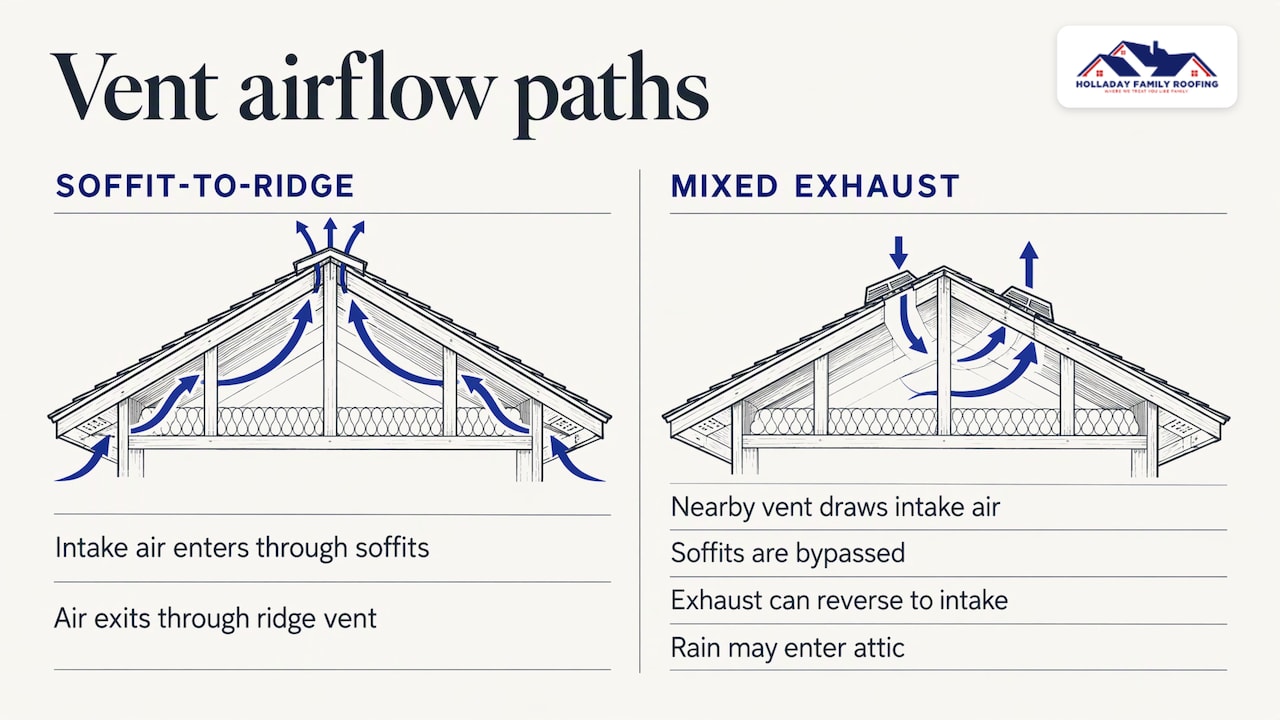
The most common design is passive. According to IIBEC's Attic Ventilation 101, outside air enters through soffit or eave vents, warms and rises, then exits through vents at or near the top of the attic. The system works when the amounts of intake and exhaust are approximately equal. Balance is the whole point.
The Home Ventilating Institute describes two jobs for that airflow:
- In summer, it reduces heat buildup. Attic temperatures can reach 150°F on hot days, and that heat can distort shingles, roof boards, sheathing, siding and insulation while making living areas harder to cool.
- In winter, it carries off moist air before it condenses on the underside of the roof, beams and rafters. Left alone, that moisture leads to mildew, wood rot, rusted fasteners and wet insulation.
Houston winters are mild, so the summer job matters most here. Long, hot, humid months put steady stress on a roof system, and a poorly ventilated attic makes the air conditioner carry the load.
What the code number means
Building codes usually set a minimum. Florida's university energy research center notes the general requirement is one square foot of free vent area for each 150 square feet of ceiling, with equal open area for inlets and exits. That is the "1/150" figure you will hear from roofers. "Net free area" means the actual open space air can pass through, not the size of the vent cover, because screens and louvers block part of the opening. Local codes can differ, so a professional should confirm what applies to your property.
The most common roof ventilation problems
Field inspectors see the same handful of faults again and again. Here is what they are and why they matter.
1. Blocked or missing intake vents
Most real-world problems come from too little intake, not too little exhaust, according to the American Society of Home Inspectors. Their checklist notes soffit vents that were never actually cut open, holes covered with felt, vents painted shut, and vents clogged with leaves and dust. Insulation pushed against the eaves can also smother the airflow, which is why baffles (rigid channels that keep insulation off the soffit openings) matter. ENERGY STAR calls blocking eave airflow the most common homeowner mistake and says soffit vents should never be covered with insulation.
2. A ridge vent with no intake underneath
A ridge vent along the peak looks like a complete solution, but IIBEC points out that a ridge vent without soffit intake is ineffective and can even pull warm, moist air from inside the house into the attic. This is common after a roof replacement where the old closed soffits were never opened up.
3. Not enough vents
IIBEC also lists too few vents as a frequent issue. Two or three static exhaust vents on a gable roof are usually not enough. Haag Engineering's building-science article calls the most damaging miscue a system that does not reach the 1/150 net free area minimum.
4. Mixed vent types that short-circuit airflow
More is not always better. Haag explains that combining powered (active) and static (passive) vents lets air take a shortcut, like punching a hole in a drinking straw. The air is pulled from the nearby vent instead of from the soffits. The home inspectors' checklist adds that mixing exhaust types, such as a ridge vent with a power vent or gable louvers, can turn one exhaust vent into an intake and invite rain and weather into the attic.
5. Powered attic fans fighting blocked soffits
ENERGY STAR warns that an attic fan in a house with blocked soffit vents and poor air sealing can pull cool, conditioned air out of the living space and into the attic. That makes the air conditioner work harder and raises summer bills. A fan is only as good as the intake feeding it.
6. Household exhaust vented into the attic
The U.S. Department of Energy's Guide to Durable Attics calls venting a kitchen range, bathroom fan or dryer into the attic a major moisture source. It can lead to mold, may violate local building codes, and should be corrected right away. This is a duct problem rather than a roof problem, but it shows up as roof and attic damage.
7. Roof leaks and air leaks that look like ventilation problems
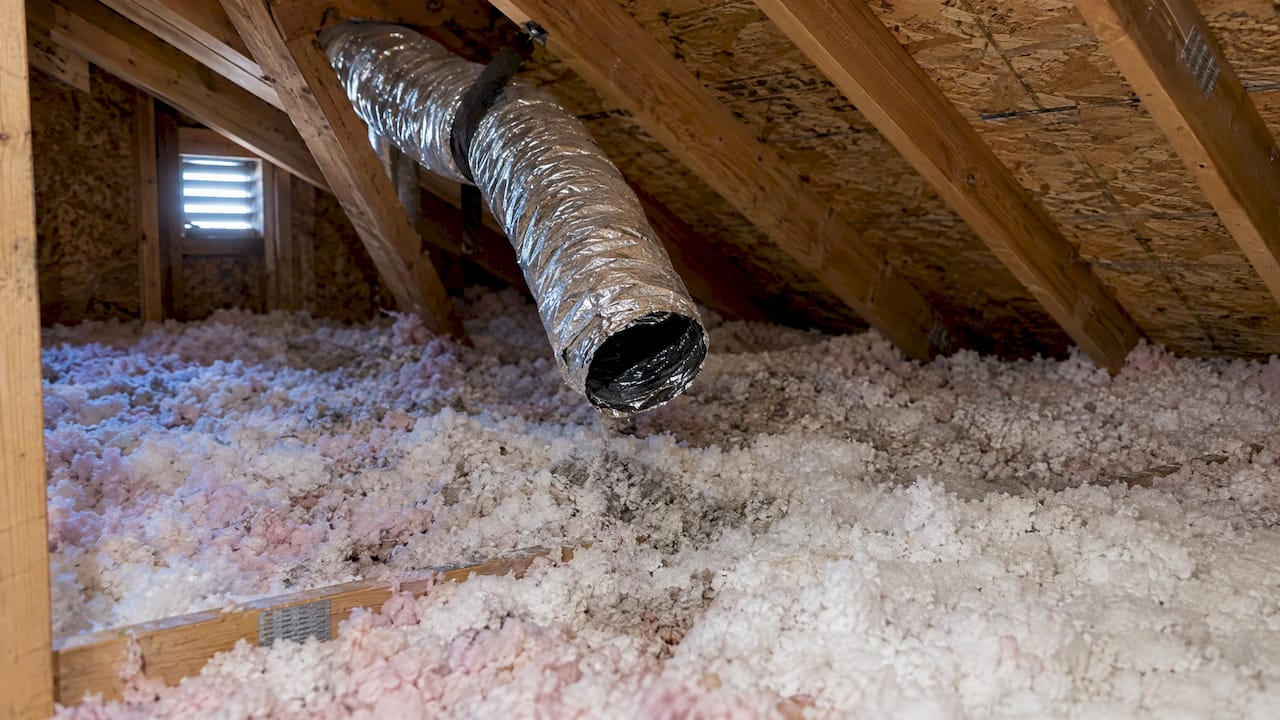
The same DOE guide names three ways moisture gets in: roof leaks or bad flashing around chimneys and penetrations, water vapor from inside or outside with nowhere to escape, and ice dams. A leaking pipe boot can leave the same stains as poor airflow. If your stains cluster around one penetration, read our guide to roof boot repair. Air leaking from the house into the attic through gaps around ducts, wires, recessed lights and plumbing also adds heat and humidity. The DOE's Building America team notes that a considerable portion of the air entering a typical house comes from the attic through such leaks.
Signs of poor attic ventilation you can check from the ground
You do not need to climb anything. Walk around the house, look up at the roof edges from the yard, and check the rooms below the attic. The DOE guide lists these indicators:
- Soffit or fascia panels that are warped or rotted
- Bubbled or peeling paint on fascia boards
- Worn or warped shingles at the roof edges
- Wet insulation, especially near the eaves
- Mold or mildew on attic surfaces
- Warped or rotting wood in the attic
Inspectors add mold stains on wood, compacted insulation from moisture droplets, and rusty nails as signs of too little ventilation.
On the living side, watch for rooms under the roof that stay hot well after sundown, an air conditioner that runs constantly, or musty smells near ceilings. If you see brown rings or dark spots on a ceiling, treat that as a possible leak first. The same kind of moisture can also show up as condensation on walls, and this overview of signs of condensation moisture in a home helps you tell the patterns apart.
Safety first
- Do not climb onto a roof you suspect is damaged. Decking weakened by moisture may not hold your weight.
- Do not poke or puncture a sagging or bulging ceiling. Trapped water can release suddenly. Move belongings and people out of the room and call a professional.
- Stay away from attic wiring, junction boxes and powered fans. If a fan or wire looks damaged, leave it alone and call a licensed electrician.
- If you see visible mold, read what to do about mold from a roof leak before touching it.
What poor ventilation does to a roof and a building
The Asphalt Roofing Manufacturers Association's February 2023 technical bulletin says missing or inadequate ventilation may result in premature failure of the roofing system, buckling of shingles from deck movement, rotting wood members, and moisture in the deck and insulation. Haag adds that improper ventilation can contribute to blisters, early granule loss, thermal cracking and curling in asphalt shingles.
The National Association of Certified Home Inspectors explains one mechanism: the volatile oils that keep asphalt shingles flexible and waterproof are lost faster when heat is trapped. The Home Ventilating Institute adds that heat and humidity can weaken structure and cause drywall and paint failures, and wet insulation loses its effectiveness and can stain interior ceilings.
For commercial owners, the same principle applies to buildings with attic or plenum spaces under pitched roofs. Low-slope roofs have different details, and our pages on flat roof repair and commercial roof inspection cover those.
What a professional checks
An attic ventilation assessment is mostly a matter of looking at the whole system, not just counting vents. Based on the home inspectors' checklist and the Insulation Institute's retrofit guidance, a thorough check covers:
- Balance. Is there exhaust near the ridge and intake at the soffits, in roughly equal amounts?
- Openings. Are the soffit and ridge holes actually cut, or covered by felt, paint or debris?
- Baffles. Are they in place so insulation cannot block the eaves?
- Mixed vent types. Are powered fans, gable louvers and ridge vents fighting each other?
- Moisture damage. Is there staining, rot, rusted nails or compacted insulation?
- Pests. Have animals gotten in through vent openings?
- Household ducts. Do the range hood, bath fans and dryer vent outside?
The numbers matter too. The 2018 International Residential Code, as summarized by Jaspector, uses 1/150 of the vented space as the baseline net free area, which can be reduced to 1/300 under specific conditions such as a vapor retarder on the warm side of the ceiling. Which ratio applies depends on how your attic is built, which is another reason to have someone measure rather than guess.
How ventilation problems are fixed
The fix depends on the cause. The DOE guide and the Insulation Institute's January 2026 retrofit guide point to the same logic: seal air leaks between the living space and the attic first, then make the ventilation balanced, with air entering at the base of the roof slope or soffits and leaving near the ridge.
| Problem | Typical correction |
|---|---|
| Blocked soffit vents | Clear debris, remove paint or covering, open closed soffits |
| Insulation covering the eaves | Install baffles to keep an air channel open |
| Too little exhaust | Add ridge or other static exhaust vents, matched to the intake |
| Mixed vent types | Remove or change the competing vent so one system does the work |
| Household exhaust in the attic | Reroute range, bath fan and dryer ducts to the outside |
| Air leaks from the house | Seal gaps around ducts, wires, plumbing and fixtures |
Some of this is roofing work, some is insulation or duct work, and some is electrical if a powered fan is involved. The DOE advises contacting a professional contractor as needed. When a roof is already near the end of its life, ventilation is easiest to correct during replacement, because the soffits, decking and vents are all exposed at once. Our pages on roof repair, roof replacement and asphalt shingle roofing explain how those jobs work.
If a ridge-line problem is part of what you are seeing, see our guide to roof ridge repair. Regular checkups catch clogged vents early, and roof maintenance service explains what a maintenance visit covers.
Cost and insurance: what to expect
Project cost depends on the cause. Clearing a blocked soffit is a small job. Adding ridge vent, baffles and intake across a whole roof, or repairing rotted decking, is a larger one. Any general range you find online is a sourced average, not a price for your roof. A project-specific estimate requires someone to look at your attic and roof. An estimate request is not a booking or a price quote.
On insurance, ventilation problems that develop slowly are generally treated as wear and maintenance, so do not assume they are covered. Whether a policy responds to any related damage depends on its wording and on the cause of the loss, and no one can promise coverage in advance. If you think a storm damaged your roof, read your policy and talk to your insurer. Holladay Family Roofing assists homeowners with insurance claims, and the Texas Department of Insurance and the Office of Public Insurance Counsel are official places to check your rights as a policyholder.
Getting your roof and attic looked at
Holladay Family Roofing has served Houston for over 20 years, with residential and commercial roofing, repairs and replacements. We offer free roof inspections and free estimates, and our work comes with a ten-year no-leak warranty. Warranty coverage is set out in the written terms for each project, so ask to see them before you sign. Our verified service areas are Houston, Pearland and Friendswood. If you are outside those areas, please confirm availability with us first.

If you are seeing warped soffits, a hot upstairs or stained decking, start with a free roof inspection, then request a free estimate at our quote form or call (832) 883-3930.
FAQ
What are the signs of poor attic ventilation?
Look for warped or rotted soffits, peeling paint on fascia boards, worn shingles at the roof edges, wet or compacted insulation, mold or mildew in the attic and rusty nails. Inside, a hot upper floor and high cooling bills are common clues. You can check the exterior from the ground; leave the attic and roof to a professional.
Can too many vents cause problems?
Yes. Combining powered fans, ridge vents and gable louvers can short-circuit airflow so the attic is not ventilated from the soffits. It can also pull weather into the attic. The goal is balanced intake and exhaust, not the most vents.
Does rain come in through roof vents?
Properly installed and matched vents are designed to keep water out. Rain intrusion usually points to a mixed system, where one exhaust vent has turned into an intake, or to a damaged or poorly flashed vent. Stains near a vent are a reason to have it inspected.
Is ventilation something I can fix myself?
Clearing leaves from reachable soffit vents at ground level is simple, but anything on the roof or in the attic involves fall, structural and electrical hazards. Cutting vents, adding baffles and rerouting ducts are professional jobs.
Should I fix ventilation before replacing my roof?
It is usually easier to correct during replacement, when soffits and decking are open. A professional can tell you whether your current roof needs repair first or whether replacement is the better route.
Sources
- Attic Ventilation, Home Ventilating Institute
- Attic Ventilation 101, IIBEC
- Guide to Durable Attics, U.S. Department of Energy
- About Attic Ventilation, ENERGY STAR
- Attic Insulation and Ventilation, Florida Solar Energy Center
- An Attic Ventilation Checklist for Home Inspectors, American Society of Home Inspectors
- Ventilation Miscues, Haag
- Technical Bulletin on ventilation, Asphalt Roofing Manufacturers Association
- Attic Ventilation Systems, NACHI
- Attic Ventilation Requirements: IRC 2018 R806.1, Jaspector
- Retrofitting Vented Attics, Insulation Institute
- 7 señales de humedad por condensación en casa