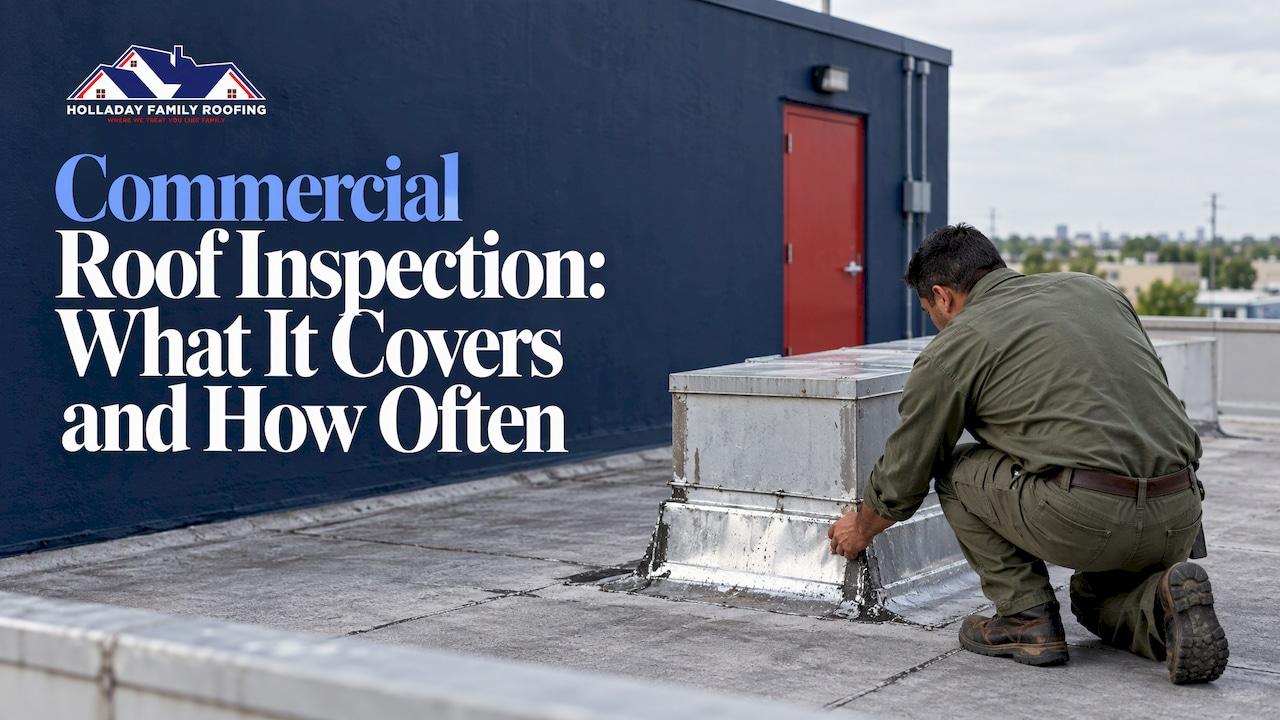
A commercial roof inspection is a documented, systematic review of your roof, from the interior ceiling to the edge flashings, that finds small defects before they become leaks. Plan on two a year, in spring and fall, plus one after any severe storm. Holladay Family Roofing offers free roof inspections in Houston, Pearland and Friendswood, and the report you receive should list every problem, where it is and what it will take to fix.
This guide explains what an inspector actually checks, when to schedule one on a Gulf Coast roof, what a useful report looks like and what to do with the findings.
TL;DR
- Inspect a commercial roof at least twice a year, ideally spring and fall, and again after hail, high wind, heavy rain or a hurricane.
- A proper inspection covers the building interior, exterior, roof surface, flashings, drainage and rooftop equipment, and it ends in a written report with photographs.
- Ponding water, open seams, loose flashing and clogged drains are the findings that most often lead to leaks.
- Keep dated inspection reports. They support warranty and insurance conversations if damage occurs later.
- Holladay Family Roofing offers free roof inspections. Request a free estimate or call (832) 883-3930.
Table of Contents
- What a commercial roof inspection is
- How often to inspect a commercial roof
- What an inspector checks
- What the inspection does not do
- Common findings and what they mean
- What the report should contain
- What to do before and after a storm
- Who can inspect a commercial roof
- How much does a commercial roof inspection cost?
- Matching the finding to the fix
- Get your roof inspected by Holladay Family Roofing
- FAQ
- Sources
What a commercial roof inspection is
A commercial roof inspection is a structured evaluation of the roof system on an office, warehouse, retail center, multifamily or mixed-use building. The inspector looks at the roof covering, the details where the roof meets walls and equipment, the drainage, and the signs of water inside the building.
The point is timing. The National Roofing Contractors Association (NRCA) explains that finding and repairing roofing problems early generally reduces both the extent of the damage and the cost of repairs. By the time a stain appears on a ceiling tile, the water has usually been working for a while. Procore's guide makes the same point: moisture found inside a building is often the symptom of a larger problem that is hard to trace.
There are also business reasons beyond the roof itself:
- Warranty. GAF, a roofing manufacturer, notes that skipping routine inspections and maintenance can jeopardize warranty or guarantee coverage.
- Insurance. The same article says carriers may deny claims after severe weather if an owner cannot show regular roof care. Your policy language decides what is covered, so read it or ask your agent.
- Tenants and contents. A roof leak damages inventory, equipment and tenant relationships long before it damages the roof deck.
How often to inspect a commercial roof
The common guidance is consistent across the industry. The NRCA recommends maintenance inspections at least twice a year, preferably spring and fall, with extra inspections after severe weather such as a hurricane, tornado or hailstorm. Allianz Commercial gives the same schedule: a complete inspection at least twice a year and again after a severe storm. Chubb adds that the right frequency depends on the roof material, its age and its location.
For a Houston-area building, that translates into a simple calendar:
| When | Why |
|---|---|
| Spring | Check for damage from winter and early-season storms before the heat and the heaviest rain months |
| Fall | Clear drains and confirm the roof is sound after hurricane season |
| After hail, high wind or a named storm | Catch punctures, lifted flashing and displaced material while the damage is fresh |
| After rooftop equipment service | GAF's checklist calls for a check after service calls to find accidental damage from technicians |
The same GAF checklist says a yearly inspection is the minimum and twice a year is optimal.
Water weight matters too. Allianz warns that water accumulating on a poorly maintained roof adds substantial dead weight and can contribute to structural collapse risk. A drain clogged by storm debris is a reason to inspect right after the storm, not at the next scheduled visit.
What an inspector checks
A good inspection follows a repeatable order so nothing is skipped. The National Roof Certification and Inspection Association (NRCIA) describes a sequence of interior, attic or plenum space, exterior, perimeter and rooftop, and points out that walking a very large roof without a system means missing something. Chubb's roofing specialists use a similar order: interior, exterior, membrane, flashings, then installed equipment.

Inside the building
The inspector looks at ceilings, walls and around penetrations for stains, damp insulation, sagging tiles, mold and rust on fasteners. This is where many leaks announce themselves first, and it is also where you can help: note which areas of the building have had stains, drips or odors, and tell the inspector.
The roof surface
The standards for commercial building inspectors from the Certified Commercial Property Inspectors Association (CCPIA) list what is examined: the roof covering, exposed membrane, slopes, evidence of significant ponding, gutters, downspouts and drainage, vents, flashings, skylights, chimneys and other penetrations. What the inspector looks for depends on the material:
- Asphalt shingles: curling, loose or torn shingles.
- Tile: cracked, missing or unattached tiles.
- Metal panels: loose screws, deteriorated rubber washers, worn or discolored paint, rust, dents.
Those material-specific checks come from the Institute for Catastrophic Loss Reduction's inspection guide. Low-slope membrane roofs add their own list: blisters, cracks, tears, punctures, and worn or failed seams.
Perimeter and flashings
The NRCA's inspection guidance describes starting at a corner and inspecting all perimeter flashings until returning to the starting point, then walking the field of the roof in rows about 5 to 10 feet apart, depending on the system. Flashing, the metal or membrane that seals the roof edge, walls and penetrations, is where a large share of leaks begin, so it earns a full lap.
Drainage
Blocked drains, scuppers and gutters turn a rainstorm into a ponding problem. Procore lists ponding water as a sign of blocked drainage or incorrect roof pitching, and long-term standing water is also associated with mold, vegetation and membrane wear.

Rooftop equipment
HVAC units, vents, curbs and conduit are penetrations and traffic points. Their flashing, their curbs and the condition of the roof around them belong in the report.
What the inspection does not do
Knowing the limits helps you ask for the right scope. Under the CCPIA standard, a general commercial property inspector is not required to walk on pitched roof surfaces, predict service life, perform a water test or warrant or certify the roof, or walk on unsafe areas. A building inspector's roof check at a property sale is therefore not the same as a roofing professional's condition review with repair recommendations. If you want a roof evaluated with repairs in mind, say so when you schedule.
Common findings and what they mean
| Finding | What it usually signals | Typical next step |
|---|---|---|
| Ponding water that lasts more than a day or so after rain | Clogged drains or low spots in the roof | Clear drains, then have a roofer assess the low area |
| Open or failed seams | Water can reach the substrate | Repair the seam before the next rain |
| Loose or lifted flashing | Common leak point at walls and equipment | Re-secure or replace and re-seal |
| Punctures, tears, blisters | Storm debris, foot traffic or aging membrane | Patch now, and watch for more |
| Rust and corrosion on metal | Fastener or panel deterioration | Replace fasteners, address the moisture source |
| Vegetation or mold on the surface | Moisture is staying on the roof | Find why water is not draining |
| Cracks or bulges | Possible structural movement | Have a roofing professional evaluate promptly |
The first five items are the ones lists from Procore and the ICLR flag most often. A small repair completed this month is nearly always cheaper than the same defect after a season of water intrusion. For a leak already underway, see our guide to commercial roof leak repair.
What the report should contain
The inspection is only as useful as its documentation. The NRCA says findings should be documented in writing and with photographs. Its inspection guidance adds that the report should include the problems found and their locations, recommended corrective actions and repairs, and a cost estimate for repairs.
Ask for these items every time:
- A roof plan or sketch that marks each finding.
- Dated photographs tied to those locations.
- A priority for each item: fix now, fix this season, or monitor.
- Repair recommendations, with a cost estimate for the work.
- A note on the roof's general condition and any material that is nearing the end of its useful life.
Keep every report in one file. Over several years the set shows the pattern of the roof's aging, supports warranty conversations and gives your insurance agent a record of maintenance. The NRCA also advises that repairs which cannot be made immediately should be made as soon as possible to limit further deterioration.
What to do before and after a storm
Houston-area owners deal with heavy rain, wind and the occasional hurricane. A short routine keeps the roof and the paperwork in order.
Before the season: have the spring or fall inspection done, clear debris from drains and scuppers, and confirm that your policy's deductible and storm provisions are what you expect.
After a storm, from the ground and inside:
- Walk the property perimeter and look at the roofline for missing material, bent edge metal, or debris on the roof.
- Check ceilings and walls inside for new stains, drips or damp insulation.
- Photograph everything with the date.
- Do not climb a damaged roof, and do not go near rooftop electrical equipment or downed lines. Do not poke or puncture a sagging ceiling. Call a roofing professional, and the electric utility for any electrical hazard.
The Texas Department of Insurance advises policyholders to tell their company as soon as possible, and notes that some policies carry a one-year filing deadline unless there is good cause for delay. That guide covers home insurance, and commercial policies differ, so confirm the deadline and notice rules in your own policy right away. For a storm-specific walkthrough, read our guide to storm damage roof repair in Houston.
Who can inspect a commercial roof
There is no federal license for roof inspectors in the United States. According to the NRCIA, some states license through contractor or building inspector boards, many do not, and requirements vary considerably by market. That puts the burden on you to judge the inspector.
What matters in practice:
- Roofing knowledge of your system type. A low-slope membrane, a metal standing-seam roof and a shingled section each fail differently.
- A written report format like the one above, delivered every time.
- Repair capability. An inspector who also repairs and replaces roofs can tell you what a fix involves and what it will cost, not just that a problem exists.
- Written terms for anything warranted. A roofer's warranty should be in a written, project-specific document, so read the terms and ask what is and is not covered.
How much does a commercial roof inspection cost?
There is no single price. The cost depends on roof size, roof type and complexity, access, and how much documentation you want. Larger roofs and add-ons such as infrared or drone imaging cost more, and a routine visual inspection costs less than a detailed condition assessment. Any dollar figure you see online is a general range for planning, never a quote for your building.
The number that matters more is the estimated cost of the repairs the inspection turns up, which is why the report should include one. A project-specific number comes only from someone who looks at your roof. Holladay Family Roofing provides free inspections and free estimates, and an estimate request through the website is a request, not a booking and not a price quote.
Matching the finding to the fix
Once you have the report, the decision is usually one of four paths.
Repair. Isolated problems such as a failed seam, lifted flashing or a puncture are repair jobs. Our roof repair service covers them.
Coating. On a roof that is still sound but weathered, a roof coating can help extend its useful life. Whether a coating suits your roof depends on its condition, which is a question for the inspection.
Replacement. When damage is widespread or the roof is near the end of its life, replacement is the sound investment. For timing and planning, see our guide to commercial roof replacement and the roof replacement page.
Metal re-roof. Some owners choose metal roofing when replacement is due and they want a long-lasting system.
Get your roof inspected by Holladay Family Roofing
Holladay Family Roofing has roofed Houston-area homes and businesses for more than 20 years, with asphalt shingle, metal, coating and repair services for both residential and commercial properties. We offer free roof inspections, and we help property owners work through insurance claims. Our replacement work carries a ten-year no-leak warranty, and the project-specific terms are written down, so you can read exactly what applies to your roof.

If you own or manage a building in Houston, Pearland or Friendswood, start with the free roof inspection. Outside those areas, call to confirm availability first.
FAQ
How often should a commercial roof be inspected?
At least twice a year, in spring and fall, and again after severe weather such as hail, high wind or a hurricane. Industry guidance from the NRCA, GAF, Chubb and Allianz agrees on this schedule. A roof with known problems or older material may warrant more frequent checks.
What is included in a commercial roof inspection?
The inspector reviews the building interior for water signs, the exterior, the roof covering, flashings, penetrations, drains and gutters, and rooftop equipment. The result should be a written report with photographs, locations of problems and recommended repairs. The scope differs by roof type, so ask what will be examined before the visit.
Do you need a license to inspect a roof?
Not at the federal level. Some states license roof inspectors through contractor or building inspector boards, and many do not. Because rules vary, judge an inspector by experience with your roof system, written reports and the ability to explain what repairs involve.
Does a roof inspection find every leak?
Not always. A visual inspection finds visible defects and the conditions that cause leaks, but it is not a water test, and general inspection standards do not require one. If you have an active leak, tell the inspector where and when it appears so they can trace the source.
Is an estimate request the same as booking an inspection?
No. Requesting a free estimate from Holladay Family Roofing starts a conversation about your roof. It is not a booking and not a price quote. A project-specific price comes after the roof has been evaluated.
Ready to find out what shape your roof is in? Request a free estimate or call (832) 883-3930.
Sources
- The benefits of maintenance, NRCA (April 2012)
- Professional Roofing, NRCA/RIEI inspection guidance (September 2001)
- ComSOP commercial inspection standards, CCPIA (2026)
- Commercial roof inspector training, NRCIA (2026)
- How to inspect and maintain your commercial roof, Institute for Catastrophic Loss Reduction (June 2022)
- The Importance of a Roof Inspection, GAF
- Commercial Scheduled Maintenance Checklist, GAF
- 3 steps to plan your commercial roof inspection, Chubb (2022)
- How to get the most out of your roof, Allianz Commercial
- Commercial Roof Inspections: Common Issues and Best Practices, Procore
- Home insurance guide, Texas Department of Insurance