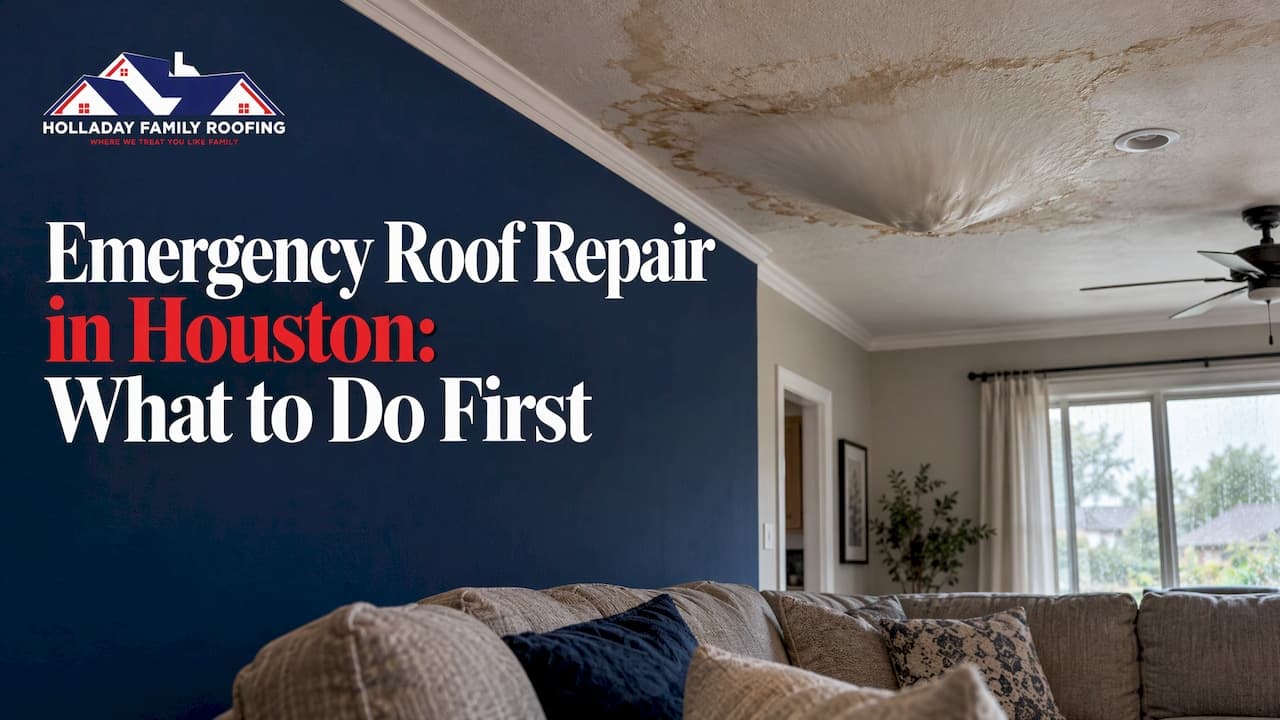
If your roof is leaking right now, stay inside, keep people away from wet or sagging ceilings and stay off the roof. Take photos from the ground and from inside, call your insurance company, and contact a qualified roofer to assess the damage and arrange a repair. A roof leak becomes an emergency when water is entering the house faster than you can contain it, or when it touches electrical fixtures, bulges a ceiling or follows a storm that removed part of the roof. This guide is for Houston, Pearland and Friendswood homeowners and explains each step.
TL;DR
- Keep everyone away from sagging ceilings and from any wet light fixture, outlet or wiring. Do not poke or puncture a bulging ceiling, and do not climb onto the roof.
- Inspect only from the ground and from inside the house, and take dated photos and video of everything.
- Tell your insurer as soon as possible. Keep receipts for emergency measures, and ask the adjuster what your policy covers.
- A temporary cover is only a stopgap. Permanent repair should come from a professional roofing contractor.
- Holladay Family Roofing offers free roof inspections and estimates. Availability and scope are confirmed with you directly, never assumed.
Table of Contents
- Is a roof leak really an emergency?
- Safety first: what to do inside the house
- Safe checks you can make from the ground
- Document the damage before anything is moved
- Calling your insurance company
- Temporary protection versus permanent repair
- How to choose a roofer when you are in a hurry
- What affects the cost of an emergency repair
- Paying for an urgent repair
- Where Holladay Family Roofing fits
- What happens after the emergency is handled
- FAQ
- Request a free estimate
- Sources
Is a roof leak really an emergency?
Not every drip needs a midnight phone call, but some situations should not wait. Treat it as urgent when you see any of these:
- Water coming through a ceiling in a steady stream, or a ceiling that is bulging, sagging or discolored in a spreading patch.
- Water near electrical fixtures, such as a ceiling light, fan, outlet or panel.
- Visible storm damage: shingles blown off, a section of decking exposed, a fallen limb or tree on the roof, or a roof edge that has lifted.
- More rain on the way while an opening in the roof is known or suspected.
A slow stain that appears only after heavy rain is still worth attention, but it is usually a repair to schedule quickly rather than a crisis. Moisture that sits in insulation and drywall causes its own problems. The EPA says that drying water-damaged areas and materials within 24 to 48 hours generally prevents mold from growing, so even a modest leak deserves a prompt response.
In Houston-area weather, heavy thunderstorms, tropical systems and high winds can all open up a roof quickly. The signs of a true emergency are the same in Houston, Pearland and Friendswood: active water entry, safety hazards, or a visibly open roof.
Safety first: what to do inside the house
The biggest dangers in a roof emergency are not the roof itself. They are the ceiling below it and the wiring above it.
Stay clear of sagging ceilings
Water can pool above drywall and add far more weight than the ceiling was built to carry. A bulging ceiling can come down without warning. Move people, pets and valuables out of that room. Do not stand under it, and do not puncture it to release the water. Leave that to a professional who can judge the structure.
Treat water near electricity as a hazard
If water is dripping from or around a light fixture, ceiling fan, outlet or wiring, keep everyone away from the area and avoid touching switches or fixtures there. Call a licensed electrician or your utility to deal with it. If you smell burning, see sparking or hear buzzing, leave the house and call 911.
Outside, watch for downed lines too. OSHA's tarping safety guidance says to treat every power line as live, contact the utility to make sure lines are de-energized, and avoid metal ladders near power lines or energized equipment.
Contain what you can from the floor
Move furniture and electronics out of the drip zone. Put buckets or containers under active drips only where the ceiling is intact and the floor is safe to stand on. Lift rugs and lay towels to limit floor damage. That is the extent of the safe DIY work.

Safe checks you can make from the ground
You do not need to be on the roof to give a roofer useful information. The National Roofing Contractors Association says homeowners should only inspect a roof system from ground level because the risk of falling is too great without proper safety systems, and it recommends a professional contractor inspect as quickly as possible after hurricane damage.
Once the weather has passed, walk around the property and look for:
- Missing, curled or visibly lifted shingles, or bare patches on the slope
- Shingle pieces or granules in the yard, driveway or gutters
- Sagging or bent gutters and torn-off flashing or vent covers
- Limbs or debris resting on the roof
- Dark streaks or wet spots on exterior walls, soffits or fascia
- A visible dip in the roofline
Inside, check:
- Ceiling stains and where they sit, including whether they are growing
- The attic only if it is safe to reach by a fixed stair or pull-down ladder, with no standing water, no wet insulation near wiring and no sagging boards. If in doubt, skip it
- Damp walls, peeling paint or a musty smell
Write down what you see and where. A leak's entry point is often several feet from where the stain appears, because water travels along decking and rafters. That is why a professional inspection matters even when the stain looks small.
Document the damage before anything is moved
Good records protect you with your insurer and help your roofer scope the work. Insurance.com advises photos and videos of the damage and keeping receipts for temporary repairs and other covered expenses. The Texas Office of Public Insurance Counsel gives similar tips: take photos or videos of the loss and find your policy to locate your deductible and contact details.
A simple documentation routine:
- Photograph the exterior from the ground, wide shots first, then close-ups of visible damage.
- Photograph every interior stain, drip and damaged item. Record a short video walking through each affected room.
- Note the date and time of the storm and when you first saw the leak.
- Save every receipt for emergency measures, such as towels, buckets or a professional temporary cover.
- Keep damaged materials until the adjuster has seen them, unless they are a safety hazard.
Do not climb up for close-up photos. A phone zoom from the yard or a drone-free angle from a neighbor's driveway is enough for the first record.
Calling your insurance company
The NAIC advises notifying your insurer as soon as you know there is damage and you decide to file a claim, and offers a checklist of questions, including your deductible and how long you have to file.
In Texas, the Texas Department of Insurance's consumer rights summary says to file your claim as soon as possible and lists processing deadlines for your insurer, starting with acknowledging your claim and beginning its investigation within 15 days after you file. Check the current TDI and OPIC pages for the full timeline that applies to your policy.
A few practical points:
- Read your declarations page first. It shows your deductible, including any separate wind or hail deductible.
- Ask what emergency steps the policy expects. OPIC's guidance is to take steps to prevent further damage and only make emergency repairs before the insurer's inspection. Permanent work typically waits for the adjuster.
- Whether a loss is covered depends on your policy and the cause of damage. Neither a contractor nor this article can promise coverage or approval. Your insurer decides that.
Holladay Family Roofing helps homeowners work through insurance claims. That means helping you understand the roof's condition and documenting it. It does not mean guaranteeing the outcome of a claim.
Temporary protection versus permanent repair
An emergency measure keeps more water out until a proper fix can be done. It is not the repair. The SPRI-NRCA emergency repair manual says emergency repairs should be considered temporary and that a professional roofing contractor should make permanent repairs as soon as weather permits.
Why we do not recommend tarping it yourself
Tarping is the most common cause of injuries in a roof emergency, and this guide deliberately gives no step-by-step instructions for it. The reasons are practical:
- OSHA says never to install a tarp during a storm while it is windy or raining, and warns that tarped roofs are very slippery, especially when wet.
- The Pacific Northwest National Laboratory's building science guidance notes that do-it-yourself tarping can be dangerous and suggests professional installation where possible.
- Roofs that are wet, damaged or steep are the worst places for a non-professional to be.
A qualified roofer has fall protection, the right materials and a trained eye for where water is getting in. Ask about this directly when you call. Whether a temporary cover can be installed, and how soon, depends on the contractor's schedule, the weather and the roof's condition, so confirm it before you plan around it.
Large disasters
After a federally declared disaster, the U.S. Army Corps of Engineers' Operation Blue Roof program, run for FEMA, can provide plastic sheeting to cover damaged roofs until permanent repairs can be arranged. It is only activated for declared disasters, so it is not an option for an ordinary storm leak.
How to choose a roofer when you are in a hurry
Storms bring out crews from everywhere, and pressure to sign fast. Slow down enough to ask these questions of any contractor:
| Question | Why it matters |
|---|---|
| Do you have a local address and phone number? | You want someone who can come back if the repair needs follow-up. |
| Will you inspect before quoting? | A repair price depends on what is under the shingles, not only what you can see. |
| Is the estimate written and itemized? | It should show what the work covers and what it does not. |
| What does the warranty cover, in writing? | Workmanship and leak terms vary by project. Get them on paper. |
| Will you walk me through the insurance paperwork? | You need photos and a clear scope, but the insurer decides coverage. |
| Are you asking for full payment up front? | Be cautious of anyone demanding it before work starts. |
If you receive a flyer or a knock on the door right after a storm, treat it the same way: ask for an inspection and a written scope, and compare it with at least one other.
What affects the cost of an emergency repair
We do not publish roof repair prices, and no honest figure can be given without seeing the roof. Online ranges for emergency repairs are very wide because the result depends on the project. The main factors are:
- Size and location of the damage. A small area near a vent differs from a section of missing decking.
- Roof type and pitch. Shingle, metal, tile and flat roofs are all repaired differently, and steep roofs take more safety equipment and time.
- Hidden damage. Wet decking, insulation and framing may need replacement once the surface is opened.
- Materials and access. Matching existing shingles, or working around trees and power lines, changes the job.
- Timing. Some contractors charge more for urgent or after-hours work. Ask whether there are extra charges before you agree.
- Repair or replacement. If the roof is near the end of its life, the better long-term answer may be a full replacement.
Treat any general cost range you read online as a rough background figure only. A project-specific estimate is based on an inspection of your roof.
Paying for an urgent repair
If the damage is covered by your homeowners policy, your insurer pays according to the policy terms after your deductible. For costs that fall on you, such as a deductible or an uncovered repair, the usual options look like this:
| Option | What to know |
|---|---|
| Savings | No interest, and the fastest route. |
| Personal loan | Usually unsecured, with terms of two to seven years and APRs from 6% to 36%, according to NerdWallet. |
| Home equity loan or HELOC | Uses your home as collateral, and HELOC rates are typically variable. |
| Credit card | Fast, but average APRs on new cards are around 23.79% and transaction fees can add cost. A 0% introductory card helps only if you repay before the promotion ends. |
LendingTree also advises comparing total cost before accepting a contractor's "0% financing" offer, because dealer fees can push the total bill up as much as 10%. Whatever you choose, compare the full cost, not only the monthly payment. Holladay Family Roofing does not make any financing claims in this guide; talk to a lender or your bank about loan terms.
Where Holladay Family Roofing fits
Holladay Family Roofing has served Houston for more than 20 years, with a family-first approach to residential and commercial roofing. For a leak or storm damage, our roof repair service starts with an inspection to find where water is getting in and what has been affected. If the roof is too far gone to repair sensibly, we also do roof replacement, including asphalt shingle, metal and tile options. For roofs you are unsure about, a free roof inspection gives you a clear picture before you decide.

Our verified service areas are Houston, Pearland and Friendswood. If you are outside those areas, call first and we will tell you whether we can help. We do not promise round-the-clock service or a set response time. When you contact us, we confirm availability and the scope of work with you. Warranty terms, including our ten-year no-leak warranty, are project specific and put in writing, so ask to see the written terms for your job.
What happens after the emergency is handled
Once the roof is dry and protected, follow through:
- Get a full inspection so hidden wet decking or insulation is found, not just the visible hole.
- Dry out the interior quickly. Remove soaked insulation or drywall as advised, and run fans or dehumidifiers to stay within that 24 to 48 hour drying window.
- Keep working with the insurer. Send photos, receipts and the roofer's written scope. Ask the adjuster what documentation they still need.
- Review the permanent repair plan in writing before work starts, with materials, scope and warranty terms.
- Plan for the next storm. Trim limbs that overhang the roof, keep gutters clear and have the roof checked after major weather.
FAQ
How do I know if my roof leak is an emergency?
It is an emergency if water is entering steadily, a ceiling is bulging or sagging, water is near electrical fixtures, or storm damage has opened the roof and more rain is expected. A small stain that appears only after heavy rain is urgent but usually not a same-night problem. In either case, document it and call a roofer for an inspection.
Can I tarp or patch my own roof?
We advise against it. OSHA warns against installing a tarp in wind or rain, and notes tarped roofs are very slippery. Falls are the main risk, so leave the roof to a professional with fall protection and call your insurer about temporary protection costs.
Does homeowners insurance pay for emergency roof repair?
It depends on your policy and what caused the damage. Many policies cover sudden storm damage, subject to your deductible, but no contractor can promise approval. Contact your insurer promptly, keep your receipts and check the current guidance from the Texas Department of Insurance and OPIC.
Does Holladay Family Roofing offer 24-hour roof repair?
We do not advertise 24-hour service or a guaranteed response time. Call (832) 883-3930 or send a request, and we will confirm availability and scope for your address in Houston, Pearland or Friendswood.
Are there loans for roof repair?
Yes, general options include personal loans, home equity products and credit cards, each with different rates and risks. Compare the total cost and talk to a lender. Holladay Family Roofing does not provide financing through this guide.
Request a free estimate
If water is getting into your home, make people safe first, then document the damage and call your insurer. When you are ready, request a free estimate or call (832) 883-3930. An estimate request is not a booking or a price quote. We will confirm availability and scope with you before any work is scheduled.
Sources
- EPA: A Brief Guide to Mold, Moisture and Your Home
- OSHA: Roof Tarping (Blue Roof) Safety
- NRCA: Hurricane roof safety guidance, October 2024
- Insurance.com: How to file a storm damage insurance claim
- Texas OPIC: Residential Property Claims
- NAIC: Post-Disaster Claims Guide
- TDI: Consumer Bill of Rights
- SPRI-NRCA Manual of Roof Inspection, Maintenance and Emergency Repair
- PNNL BASC: Installing Roof, Window and Door Tarps
- U.S. Army Corps of Engineers: Temporary Roofing
- NerdWallet: Best Roof Financing Options
- LendingTree: Roof Financing Options