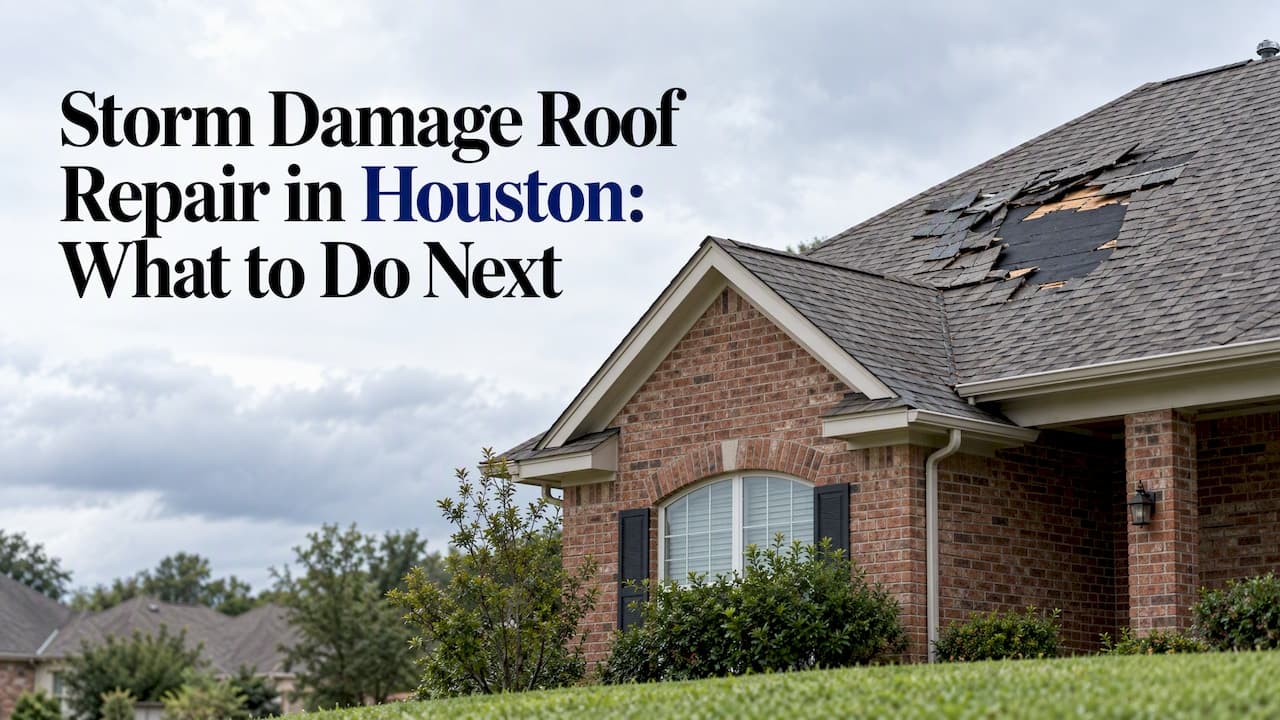
If a storm just hit your roof, do four things in order. Get everyone safe. Photograph the damage from the ground. Cover any opening with a temporary fix. Call your insurance company before you approve permanent repairs. Then have a qualified roofer inspect the whole roof, because storm damage often hides in places you can’t see from the yard.
This guide covers how to recognize hail and wind damage, what shingles blown off a roof mean, how a Texas claim usually flows, what repairs cost, and when a repair stops making sense and a replacement does. We have repaired and replaced roofs in the Houston area for over 20 years, so we write it the way we’d explain it to a neighbor.
TL;DR
-
Stay off the roof. Check for downed power lines, gas leaks and exposed nails first, then document the damage from the ground.
-
Make only temporary repairs, such as a tarp, and keep every receipt. The Texas Department of Insurance advises against permanent repairs before the adjuster inspects.
-
Hail shows up as granule loss, bruises and fractures. Wind shows up first at the roof edges, with lifted, creased or missing shingles.
-
Check your policy for wind/hail deductibles and for whether the roof is paid at replacement cost or actual cash value.
-
Get a free roof inspection and compare more than one contractor bid against the adjuster’s report before you settle.
Table of Contents
First: Make Sure Your Home Is Safe
The roof can wait an hour. Your safety can’t. The National Weather Service warns that inspecting a home after a storm can expose you to downed power lines, gas leaks, exposed nails, broken glass, fire and electrocution hazards. Stay clear of any downed line, and use a flashlight instead of candles inside a damaged home.
If you smell gas, leave and call your gas utility or 911 from outside. If water is coming through a ceiling near light fixtures, stay away from that area and shut off power to it at the breaker if you can reach the panel safely.
Then resist the urge to climb up. The National Roofing Contractors Association (NRCA) cautions homeowners not to climb a ladder in the dark or on unstable ground, and not to attempt roof repairs except in extreme situations. Wet shingles, loose granules and a weakened deck are a bad combination under your feet.
How to Tell Whether Your Roof Has Storm Damage
Start at ground level with binoculars, then walk the property. Look at the roof, the gutters, the yard and everything else the storm touched. Roof damage rarely shows up alone.
Signs of hail damage on shingles
The NRCA identifies hail damage to asphalt shingles by granule loss, material removal at shingle edges, penetration, splitting and fractures. The same guidance notes that much hail damage is cosmetic, while severe damage may require replacement. That is why a trained eye matters: a roof can look speckled and fine, or look fine and be bruised through the mat.
What to look for from the ground and in the yard:
-
Dark or bare spots where granules were knocked off, often with granules piled at downspout outlets
-
Dents or dings in soft metals such as vents, flashing and gutters
-
Cracks, splits or small punctures in shingles you can see from a ladder-free vantage point
-
Fresh, shiny spots where the asphalt is exposed
Check the rest of the house too. InterNACHI says hail collateral damage can appear on siding, trim, windows, doors, window-well covers, air-conditioning units and other exterior items as cracks, dents, punctures, broken glass or dislodged materials. It also notes that scratches or creases in an indentation are inconsistent with hail damage, so a mark that looks like a dent may have another cause. Collateral damage on the AC unit or window screens helps confirm that hail actually fell at your address.
Signs of wind damage
Wind works from the outside in. The NRCA says wind damage commonly begins at the roof edges, where loosened materials can lift, peel back and expose the roof deck. Debris can also damage roofing and clog drains and downspouts.
Signs to check:
-
Shingles lifted, curled, creased or folded back along the eaves, rakes and ridge
-
Bare patches where shingles are gone
-
Torn or displaced flashing, especially around chimneys and vents
-
Branches or other debris on the roof or in the gutters
Shingles blown off the roof
Missing shingles are the clearest sign of wind damage, and they are urgent. Once a shingle is gone, the underlayment is the only barrier left, and a single rain can get water into the deck and insulation. Pick up any shingle pieces you find in the yard and keep them. They help your roofer see the shingle type and condition, and photos of them support the claim.
Also look at the shingles around the gap. A shingle that blew off often took its neighbors’ seal strips with it, so the repair can be larger than the hole suggests. A roofer will check whether the surrounding shingles are still bonded down or are ready to go in the next gust.
Damage you can find from inside
Walk through the house with a flashlight. The National Insurance Restoration Council lists ground-visible signs such as missing shingles, displaced metal around chimneys, damaged exhaust pipes, and damage at valleys, outer edges and roof-to-wall transitions, and says attic leaks and water stains can indicate additional damage. Look at the attic underside of the deck, ceiling corners, and around light fixtures. Brown rings, damp insulation or a musty smell mean water is getting in.

Document Everything Before You Touch Anything
The Texas Department of Insurance advises homeowners to call the insurer, photograph and video the damage, make only temporary repairs to prevent additional damage, and keep repair records and receipts. A simple routine:
-
Take wide photos of each side of the house, then close-ups of every damaged area.
-
Shoot video as you walk around, narrating the date and what you see.
-
Photograph interior water stains and any damaged belongings.
-
Write down the date and time of the storm and when you first noticed damage.
-
Save damaged materials, such as shingle pieces and broken flashing, until the claim is settled.
The National Association of Insurance Commissioners (NAIC) adds that an adjuster will inspect and estimate the damage and may ask for a home inventory, so gather policy documents, damaged-property records, photographs, receipts and other supporting documentation in one folder now.
Temporary Repairs: Stop the Water, Not the Claim
Your policy generally expects you to prevent further damage, and temporary protection is the right call. The NAIC guide advises securing the home with tarps, boards or other waterproof materials, filing the claim promptly, keeping emergency-repair receipts, and postponing permanent repairs until the insurer has been consulted. The NRCA likewise says roof openings should be temporarily covered with tarpaulins to minimize rain damage.
In practice:
-
A professionally installed tarp is safer than a DIY one. Tarps that are poorly fastened flap, tear and can make the damage worse.
-
Board up broken windows and cover interior items with plastic.
-
Keep itemized receipts for materials and labor.
-
Don’t tear off or replace anything permanent until the adjuster has seen it.
If you need a tarp or a quick stop-gap on a Houston-area roof, our team can help with that as part of roof repair, and we document what we find so it supports your claim.
Will Insurance Cover Storm Damage to Your Roof?
Often, yes, depending on your policy. The Insurance Information Institute says standard homeowners insurance generally covers storm wind and hail, but wind/hail deductibles are common in severe-storm regions and typically range from 1% to 5%. Policy wording and state rules control, so read your own declarations page.
Here is what the numbers can look like. Say a policy has a percentage deductible set at 1% of the insured dwelling value. On a home insured for $300,000, that is $3,000 out of your pocket before the insurer pays. At 2%, it would be $6,000. A small repair may then fall below the deductible, while a full replacement clears it comfortably. This is an illustration of the arithmetic, not a quote for any policy.
Deductible: what you pay first
A deductible is the portion of a loss you pay before insurance begins paying. Texas guidance is specific here: contractors may not waive or rebate a homeowner’s deductible, and insurers may request proof that you paid it, such as a receipt or canceled check. If a roofer promises to “cover your deductible,” walk away. That is a red flag, not a discount.
ACV or RCV: how the payout is calculated
The Texas Office of Public Insurance Counsel explains that actual cash value (ACV) is the cost to repair or replace covered property minus depreciation for age and wear. Replacement cost value (RCV) is the cost to repair or replace covered property without that depreciation deduction. Your deductible, policy limits and coverage terms still apply. Even an RCV policy may settle a roof at ACV, and insurers commonly release remaining replacement-cost benefits after proof of repair. Check your roof endorsements and ask your insurer how your claim will be settled. Source: https://www.opic.texas.gov/residential-property-insurance/basics/acv-vs-rcv
Roof age matters a lot here. The Insurance Information Institute says coverage for roof damage depends on the covered peril, roof age and condition, material and shape, and that older roofs may be insured only at actual cash value rather than replacement cost. If your roof is 15 years old and your policy pays ACV, depreciation will reduce the check, and you should know that before you plan the budget.

Working with the adjuster
Texas guidance suggests you contact your insurance company promptly, keep a record of conversations, try to be present for the adjuster and point out all damage, and get multiple contractor bids to compare with the adjuster’s report before settling the claim. Being on site matters. An adjuster has limited time on a roof, and you or your contractor can point out the creased shingles on the back slope that are easy to miss.
If the adjuster’s scope and your contractor’s scope disagree, that is common and fixable. The NRCA’s view is that a roof assessment should determine whether the damage makes the roof a total loss and the size of the roof system and quantity of materials required, and that discrepancies between an adjuster and a contractor can justify a reinspection. Ask your insurer how to request one.
Our Offer for Houston-Area Homeowners
We offer a free roof inspection for homes and commercial buildings in Houston and nearby communities, including Pasadena, Pearland, Sugar Land, League City, Friendswood, The Woodlands, Waller and Galveston. We look at the whole roof, document what we find with photos, and explain it in plain terms. We also help homeowners work through the insurance claim process, and we back our work with a ten-year no-leak warranty.

If the inspection shows a problem, the next step is a written estimate. Estimates are free. You can compare it against the adjuster’s report and any other bids you collect. To start, visit Holladay Family Roofing and request your inspection.
Repair or Replace? How the Decision Gets Made
Not every storm-damaged roof needs to come off. The question is how much of the roof is compromised and whether a repair will hold.
Repair usually makes sense when:
-
Damage is limited to a slope or a few areas, such as wind-lifted edge shingles or damaged flashing
-
The surrounding shingles are still bonded and flexible
-
The deck underneath is dry and sound
Replacement is worth considering when:
-
Hail has fractured or bruised shingles across multiple slopes
-
Widespread granule loss leaves the mat exposed
-
Water has soaked the decking or insulation
-
The roof was already near the end of its life, so a patch buys little time
The NRCA’s note that much hail damage is cosmetic cuts both ways. Some damage won’t affect performance, but a roofer should confirm that in person, not by guess. A trained inspector checks the shingle mat, not just the surface.
If replacement is the answer, you also get to choose what goes on. Asphalt shingle roofing is the familiar, widely used option. Metal roofing is another route for homeowners who want a different material, and our roof replacement page covers the full process, including tile roofing. For commercial and flat roofs, roof coatings can be part of the conversation. Ask your insurer how a material upgrade would affect your claim before you commit.
What Storm Damage Roof Repair Costs
Cost depends on what broke and how much of it. Bob Vila’s cost guide reports hail-damage roof repair at $700 to $4,000 (updated June 2023) and says roof design, damage extent, labor, materials, location and local market conditions influence pricing. Treat that as a national range, not a Houston quote.
What moves your number up or down:
-
Extent: replacing a handful of shingles costs far less than redoing a slope.
-
Roof design: steep pitches, many valleys and dormers add labor and safety costs.
-
Underlying damage: wet decking or insulation adds to the scope.
-
Material: shingles, metal and tile price differently.
-
Access and timing: demand surges after a big storm can affect scheduling and pricing.
We don’t publish fixed prices because every roof is different. The reliable way to know your number is a written estimate after an inspection. Ours are free.
How to Choose a Roofer After a Storm
After a major storm, crews arrive in your neighborhood knocking on doors. Some are good. Some are not. Protect yourself with a few habits:
-
Get more than one bid. Texas guidance recommends comparing multiple contractor bids with the adjuster’s report before you settle.
-
Never accept a deductible waiver. Contractors may not waive or rebate it in Texas.
-
Ask for the scope in writing, including materials, underlayment, flashing, cleanup and the warranty terms.
-
Check that the company has a local address and a track record. A business that has worked in your area for years will still be around if the roof needs attention later.
-
Don’t sign over claim decisions under pressure. A good contractor explains the options and gives you time.
-
Keep the paperwork. Contracts, invoices, photos and receipts all matter if the claim is reviewed.
We have served the Houston area for more than 20 years, and our approach is family-first: we explain what we see, show you the photos and let you decide.
What to Expect from Start to Finish
A typical Houston-area storm claim moves through these stages, though timing depends on your insurer and the size of the loss:
-
Safety check and ground-level documentation
-
Temporary protection and receipts
-
Claim filed with your insurer
-
Professional inspection and written estimate
-
Adjuster inspection, ideally with you or your roofer present
-
Comparison of the adjuster’s scope against contractor bids; reinspection if they differ
-
Permanent repair or replacement once the claim position is clear
-
Final photos, invoices and warranty paperwork filed with your records
FAQ
What should I do first if a storm damaged my roof?
Check for hazards such as downed power lines, gas leaks and exposed nails, then photograph the damage from the ground. Call your insurance company, cover any openings with a tarp, and keep receipts. Avoid permanent repairs until the adjuster has inspected.
How can I tell if my roof has hail damage?
Look for granule loss, cracks, splits, fractures and bruised spots on shingles, plus dents on vents, flashing, gutters and your AC unit. Because some hail damage is cosmetic and some is serious, a professional inspection is the reliable way to tell the difference.
Does homeowners insurance cover wind and hail damage to a roof?
Standard homeowners policies generally cover storm wind and hail, but your deductible, roof age and whether the policy pays replacement cost or actual cash value determine what you receive. Wind/hail deductibles are often a percentage of the home’s insured value. Read your declarations page or ask your insurer.
Can a roofer waive my deductible in Texas?
No. Texas insurance guidance says contractors may not waive or rebate a homeowner’s deductible, and insurers can ask for proof you paid it. Be cautious with any contractor who offers to absorb it.
Is it safe to fix missing shingles myself?
We don’t recommend it. The NRCA advises against attempting roof repairs except in extreme situations, and storm-damaged roofs are slippery and may have a weakened deck. A temporary tarp is the usual stop-gap until a roofer can inspect.