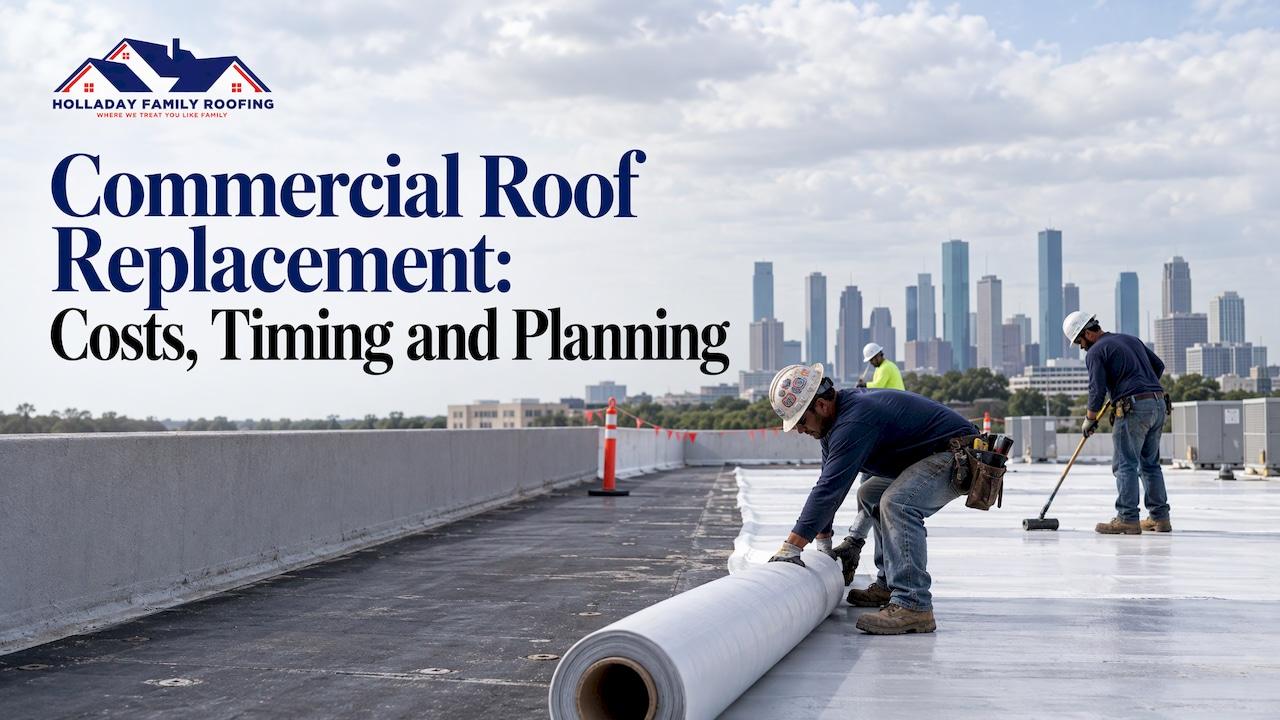
A commercial roof needs replacement when repairs keep adding up, when moisture has spread into the insulation or deck, or when the system has reached the end of its design life, which the NRCA puts at about 20 years for most commercial roofs. National installed prices for replacement currently land between roughly $7.50 and $16.00 per square foot, depending on the system. Your own number depends on the building, and only a roof inspection and a written estimate can give you that.
This guide walks Houston-area building owners and property managers through the decision, the cost drivers, the schedule, permits, insurance and the questions to settle before you sign a contract.
TL;DR
- Replace when moisture is widespread, insulation is wet, the deck is deteriorating or repair bills keep climbing. Repair or recover when the problem is local and the roof below is sound.
- Most commercial roof systems have a design life of about 20 years, so plan and budget well before leaks start.
- Recent national figures put replacement at about $7.50 to $16.00 per square foot installed. Treat that as a planning range, not a quote.
- Storm damage claims go better with prompt photos taken from safe locations, a professional inspection and a close read of your policy.
- A free inspection from Holladay Family Roofing is a low-pressure way to learn where your roof stands before you budget.
Table of Contents
- How to tell replacement from repair
- Full replacement or recover
- What a commercial roof replacement costs
- How often a commercial roof should be replaced
- Choosing a roof system
- What to expect during the project
- Storm damage and insurance
- Questions to settle before you sign
- Commercial roof replacement with Holladay Family Roofing
- FAQ
- Sources
How to tell replacement from repair
The short rule: repair fixes a problem, replacement fixes a roof. If leaks are isolated and the rest of the membrane, insulation and deck are dry and solid, repairs make sense. If the problems are everywhere, they are not repairs anymore.
A manufacturer's decision guide says a full tear-off and replacement is the right approach when widespread moisture, damaged insulation, multiple roof layers or deck deterioration make recovery impractical. A recover, meaning a new membrane over the existing roof, can extend service life only when existing conditions and codes allow it.

Signs from the ground and from inside
You do not need to climb onto the roof to spot warning signs, and you should not. Look for these from the parking lot, a neighboring building's safe vantage point or inside the building:
- Ceiling stains that return after being repaired or painted
- Stains that grow after heavy rain, or damp spots along walls near the roofline
- Ponding water that is still standing on the roof a day or more after rain, visible from an upper window or adjacent structure
- Blistered, split or visibly peeling roofing material at the edges
- Debris, granules or loose flashing near downspouts and at the ground
- Rising energy bills with no other explanation
If a ceiling is sagging, stay out from under it and keep people away. Do not poke or puncture it to drain water, and keep clear of any light fixtures or wiring near wet areas. Call a professional.
The repair math
One rough test is how often you are calling for repairs. Another is the age of the system. A roof past about 15 years that needs its third or fourth repair in a couple of years is usually telling you something. A 2026 industry planning page suggests the window between approaching end of life and actively failing is often 2 to 4 years, and that waiting too long adds interior and insulation damage to the final bill. Treat that as a general planning guide rather than a rule for your building.
If you are still weighing a fix, our guide to commercial roof leak repair covers what to do and what it costs, and our roof repair service page explains how we approach smaller jobs.
Full replacement or recover
When a roof reaches the end of its design life, building owners generally have two options, according to a facility manager's guide from IFMA's journal: a complete replacement that removes all materials down to the structural deck, or a re-cover that leaves the original roof in place and installs a new system over it.
| Full replacement (tear-off) | Recover (re-cover) | |
|---|---|---|
| What happens | Old roof removed to the deck, new system installed | New system installed over the existing roof |
| Best when | Wet insulation, deck damage, multiple layers | Existing roof is dry and sound, and codes allow it |
| Lets you inspect the deck | Yes | No |
| Upfront cost | Higher | Lower |
| Disruption | More debris and noise | Typically less |
The deciding factor is what is under the surface. A recover over wet insulation traps the moisture, so a moisture survey or a core sample from a qualified roofer is worth having before you pick.
What a commercial roof replacement costs
Price per square foot is the standard way to budget. A May 2026 business report on commercial roofing says most replacements now land between $7.50 and $16.00 per square foot, reflecting a higher post-2023 baseline for materials and labor. The same report lists these averages by system:
| Roof system | Average installed cost per sq ft |
|---|---|
| Modified bitumen | $4 to $8 |
| EPDM | $5.50 to $8 |
| TPO single-ply | $6 to $10 |
| Standing-seam metal | $10 to $18 |
Those are national, sourced general ranges. They are not a price for your building and not a Holladay Family Roofing quote.
A worked example
Take a 20,000-square-foot flat roof. At $7.50 per square foot the math gives $150,000. At $16.00 it gives $320,000. That spread is why a measured, written estimate matters more than any average. Multiply your own roof's square footage by both ends of the range to get a rough budget band, then replace it with real numbers.
What moves the price
- System choice. Metal costs more upfront than most single-ply or bitumen options. It is also built for a long service life.
- Roof size and shape. Penetrations, curbs, skylights, parapets and drainage details add labor.
- Condition of what is underneath. Wet insulation and rotted deck must be replaced. Industry planning guidance says replacing too late can add $2 to $5 per square foot in water and deck damage.
- Insulation and code requirements. The IFMA guide notes that the energy code sets how much continuous insulation goes above the deck on commercial buildings, and that the 2024 building code cycle addressed structural evaluation for ponding where only positive drainage is provided.
- Access and building use. Tight sites, occupied tenant spaces and rooftop equipment affect scheduling and crane or hoisting needs.
- Timing. Storm seasons, material lead times and demand after major weather events can all change pricing.
A free estimate from a roofer is a project-specific scope and price for your building. It is not a booking and it is not binding until you sign a contract.
How often a commercial roof should be replaced
The NRCA says the design life of most commercial roof systems is about 20 years, and that comprehensive preventive maintenance can help extend a roof's useful life. Actual life depends on the system, the climate and how well the roof has been kept up.
Houston is hard on roofs. Heat, intense sun, heavy rain, humidity and hurricane-season wind all wear materials faster than a mild climate would. A planned inspection after major storms and once a year is a sensible habit.
For owners with a roof that is aging but not yet failing, a roof coating can be part of the conversation. Coatings are designed to protect a roof's surface and extend its life when the underlying roof is still in suitable condition. An inspection will show whether that fits your building or whether replacement is the safer move.

Choosing a roof system
Commercial buildings use several kinds of roofs, and the best one depends on the roof's slope, the building's use and your budget horizon.
- Low-slope and flat systems such as single-ply membranes, modified bitumen and built-up roofing are common on warehouses, retail centers and office buildings.
- Metal roofing suits many commercial and light-industrial buildings and is known for durability. See our metal roofing page for what we install.
- Asphalt shingle roofing fits steeper-slope buildings such as small offices, multifamily and mixed-use properties. See our asphalt shingle roofing page.
- Tile roofing appears on some commercial and multifamily properties and is part of our roof replacement work.
When you compare options, ask for the life expectancy, the warranty terms in writing and the total installed cost, not just the material price. Then match them against how long you plan to own the building.
What to expect during the project
A commercial replacement is more of a logistics job than a repair visit. A 2026 industry installation guide describes a commercial roof installation as running anywhere from about 4 to 12 weeks with weather days adding to the schedule. Many smaller roofs go faster, and your contractor's written schedule is the one that counts.
Here is a typical order of work:
- Inspection and scope. The roofer measures the roof, notes drainage, penetrations and conditions, and may test for wet insulation.
- Written estimate and contract. You get the scope, materials, schedule and warranty terms in writing.
- Permit. The roofer or owner applies for any required permit.
- Material ordering and staging. Lead times vary by product.
- Tear-off and deck repair. Old roofing comes off, and any damaged deck is repaired or replaced.
- Installation. Insulation, membrane or panels, flashing and edge details go in.
- Final inspection and walkthrough. You review the finished work and receive warranty paperwork.
Tell your tenants and staff early. Ask the contractor about debris control, parking and entrance protection, work hours and how interior spaces will be protected from dust and water during tear-off.
Permits in Houston
Within the City of Houston, a new commercial roof or overlay requires a permit. The city's permitting center lists a commercial roofing permit that requires plan review and inspection, with a stated processing time of 10 business days and a validity period of 6 months. Fees and rules change, so confirm current requirements on that page. Pearland, Friendswood and other nearby cities have their own processes, so ask your roofer which jurisdiction applies to your address.
Storm damage and insurance
This is where many Houston owners start the conversation, so a few practical steps help.
- Make it safe first. Do not walk on a wet, damaged or unstable roof. Photograph what you can see from the ground, from windows or from other safe spots. Record the storm date.
- Limit further damage. Ask a roofer about temporary protection such as tarping. Keep receipts. Our guides on storm damage roof repair and emergency roof repair cover the first steps.
- Read your policy. Look at your deductible, especially any separate wind and hail deductible. The Texas Department of Insurance advises asking your agent whether wind and hail deductibles differ from other deductibles. That page is written for home insurance, so commercial policy terms should be confirmed with your agent or broker.
- Report the claim promptly and keep a record of every conversation, adjuster visit and document.
- Get a professional inspection. A written roof report from a roofer can help you understand the damage you are describing to the insurer.
Keep in mind that the TDI page says insurers will not pay for a new roof just because it is old or worn out. Coverage depends on your policy and on whether a covered event caused the damage. Holladay Family Roofing helps property owners through the claims process, but we cannot promise coverage or a particular outcome, because the insurer makes that decision.
Will a new roof lower your premium?
It can, but it is not automatic. The TDI page advises considering roofing materials that are less likely to be damaged by wind, hail or fire and notes your insurer might give you a discount for using them. That guidance addresses homeowners' policies. For a commercial building, ask your agent or broker before choosing materials which roof types and ratings qualify for credits, and get any discount confirmed in writing.
Questions to settle before you sign
- Is the quote a full tear-off or a recover, and why?
- What happens if wet insulation or deck damage is found once the old roof is off, and how is that priced?
- Which permit applies, and who pulls it?
- What is the written warranty, who stands behind it and what does it exclude? Warranty coverage varies by project, so rely on the written terms for your job.
- What is the schedule, and how are weather delays handled?
- How will tenants, staff and customers be protected during the work?
Get more than one written estimate if you like, and compare scope line by line, not just the bottom line. If you are collecting bids, our guide to getting a free roofing estimate explains what a good estimate should contain.
Commercial roof replacement with Holladay Family Roofing
Holladay Family Roofing has served Houston for over 20 years on residential and commercial roofs. Our verified primary service areas are Houston, Pearland and Friendswood. If your property is elsewhere, please contact us to confirm availability.
We start with a free roof inspection so you know the condition of your roof before you spend anything. If replacement is the right call, our roof replacement service includes written estimates, and our ten-year no-leak warranty is described in the project's written terms, which you should read for exactly what it covers.

We can also help with insurance claim paperwork when storm damage is involved, and we treat your building with care and attention to detail.
FAQ
How much does it cost to replace a commercial roof?
Recent national figures put most commercial replacements at roughly $7.50 to $16.00 per square foot installed, depending on the system. Your cost depends on size, roof condition, system and code requirements. A written estimate for your building is the only reliable number.
How often should a commercial roof be replaced?
The NRCA says most commercial roof systems have a design life of about 20 years. Maintenance, climate and system type change that, so have the roof inspected regularly to plan ahead.
Will a new roof reduce my commercial insurance?
Possibly. Texas regulators note that insurers may discount impact-resistant or fire-resistant materials on home policies. For a commercial policy, ask your agent or broker what credits apply before you choose materials.
Do I need a permit to replace a commercial roof?
In the City of Houston, yes. A commercial roofing permit is required with plan review and inspection. Other cities have their own rules, so confirm with your roofer or local building department.
Can I recover instead of tearing off the roof?
Sometimes. A recover can work when the existing roof is dry and sound and codes allow it, but wet insulation, multiple layers or deck damage point toward full replacement. An inspection will tell you which applies.
Ready to find out where your roof stands? Request a free estimate or call (832) 883-3930.
Sources
- Elevate Commercial Roofing Decision Guide
- A Facility Manager's Guide to Roof Replacement
- Capital Planning and Roof Reserves, Flat Roof Report
- Commercial Roofing as a Business Asset, B2BNN
- Planned maintenance for commercial roofing, NRCA
- Commercial Roof Installation 2026 guide, The Roofing Brief
- Commercial Roofing Permit, Houston Permitting Center
- Insurance and your roof, Texas Department of Insurance