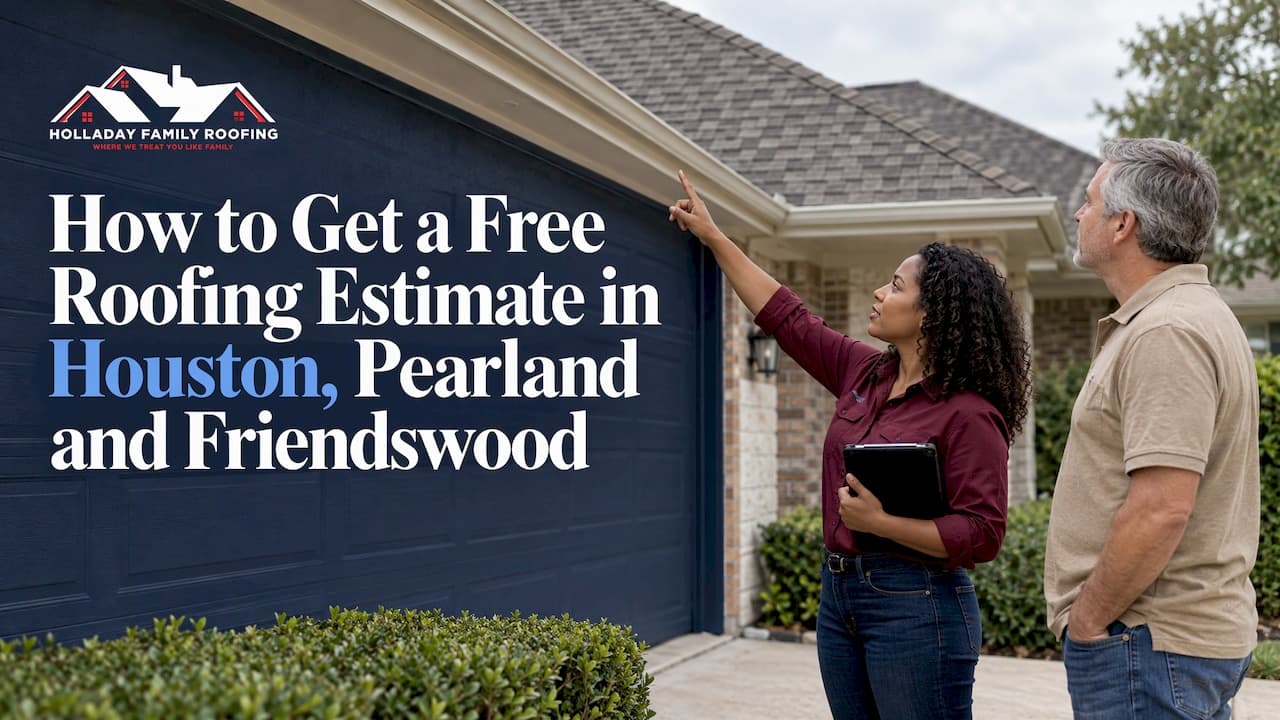
To get a free roofing estimate, send a roofer your property city, your contact details and a short description of the roofing problem. The roofer then looks at the roof and writes up the work. With Holladay Family Roofing, you can do that through our online estimate form or by calling (832) 883-3930. We serve Houston, Pearland and Friendswood. If you are outside those cities, ask us to confirm availability first. An estimate request is not a booking and it is not a price quote. It is the first step toward a written scope you can read, compare and question.
TL;DR
- A free estimate request starts a conversation and a written scope of work. It does not book a crew, and it is not a final price.
- Send three things: the property city, your contact details and a few sentences about what you see (a stain, missing shingles, a leak, storm damage, age).
- Material, roof size, slope, access, existing damage and the repair-versus-replacement question all shape the written scope.
- Compare bids line by line on materials, scope, cleanup, permits, timeline, payment terms and warranty. Do not compare totals alone.
- Ask for warranty terms in writing for your specific project. We do not promise a universal warranty or an insurance outcome.
Table of Contents
- What a free roofing estimate is
- Estimate request, booking and price quote: three different things
- How to request your free estimate, step by step
- What shapes the written scope
- Online estimates versus an on-site visit
- How to compare written scopes from different roofers
- Why the final price can differ from the estimate
- Estimates and insurance claims
- Spotting a sales pitch instead of an estimate
- Questions to ask any estimator
- What you get from Holladay Family Roofing
- Request your free estimate
- FAQ
- Sources
What a free roofing estimate is
A roofing estimate is a contractor's written guide to what a job is likely to involve and cost. Owens Corning says a useful estimate outlines the materials, labor, timeline, scope and protections, not just a number at the bottom. GAF adds that it should break out labor, materials, building permits, dump fees and taxes.
The "free" part is common in the industry. One consumer-focused article notes that roof estimates are typically free, while roof inspections can cost $75 to $600. The two are different services. An estimate is about pricing a job. An inspection is about documenting the condition of the roof, and it can matter when you are sorting out the cause of a problem.
At Holladay Family Roofing, we offer free estimates and a free roof inspection. If you are not sure whether you need a repair, a replacement or just a second opinion, the inspection is a good place to start.

Estimate request, booking and price quote: three different things
These terms get mixed up, and the mix-up causes most of the frustration homeowners report.
| Term | What it means | What it does not mean |
|---|---|---|
| Estimate request | You tell us about the property and the problem so we can look at the roof and prepare a written scope. | It does not reserve a crew or a start date. |
| Written estimate | A document describing the recommended work, the materials and the expected cost, based on what can be seen and measured. | It is not a promise that nothing will change if hidden damage turns up. |
| Booking or signed contract | An agreement you sign after reviewing the scope, terms and warranty. | It does not happen by filling out a form. |
Submitting the form commits you to nothing. You decide after you have read the written scope.
How to request your free estimate, step by step
- Gather a few facts. Note the city where the property is, the approximate age of the roof if you know it, and the material (asphalt shingle, metal, tile, a flat coated roof).
- Describe the problem in plain words. "Water stain on the hallway ceiling after heavy rain" is more useful than "roof problem." Mention when you first noticed it and whether it has gotten worse.
- Use the form or call. Go to the estimate request form or call (832) 883-3930.
- Share how to reach you. Give a phone number and email, plus any good times to talk. We do not promise a specific response time, so if your issue is urgent, say so in your description.
- Expect a roof evaluation. A written scope depends on someone actually looking at your roof. More on that below.
- Read the written scope before deciding. Take your time, ask questions and hold on to the paperwork.
What to include in your request
The more specific you are, the less back-and-forth you need.
- Property city: Houston, Pearland or Friendswood. If you are in a nearby community, tell us and we will confirm whether we can help. We do not want to imply coverage we have not verified.
- Contact details: name, phone, email and the property address if you are comfortable sharing it.
- A short description of the issue: leaks, stains, missing or curling shingles, damaged flashing, storm damage, an aging roof you want assessed, or a plan to switch materials.
- Property type: home or commercial building.
- Photos from the ground: a clear shot of the whole roofline from the yard or street, plus any interior ceiling stains, are plenty. If you have a phone with a zoom lens, use it from the ground.
Safety while you wait
Stay off the roof. A storm-damaged or wet roof is dangerous to walk on, and ground-level photos are enough for a first look. If a ceiling is sagging or bulging with water, do not poke or puncture it. Keep people out from under it and call a roofer or a qualified water-damage professional. If water is near light fixtures, outlets or wiring, stay away from that area and call a licensed electrician. Never work near electrical hazards yourself.
What shapes the written scope
Two houses on the same street can get very different estimates. The research on roof pricing points to the same handful of drivers, and they are the things we will look at with you.
Roof material
Asphalt shingles generally cost the least of the common options, while metal, wood, slate, clay or solar materials usually cost more. We install asphalt shingle roofing, metal roofing and tile roofing, and we apply roof coatings. If you are weighing two materials, ask for the scope on both so you can compare them side by side.
Size
Roof size is the biggest cost factor in a residential estimate. Roofers measure in "squares," and one square is 100 square feet of roof surface. Note that roof surface is larger than the footprint of the house because of the slope, so a floor-plan square footage is only a starting point.
Slope and complexity
A steep pitch is harder and slower to work on. So is a roof with many valleys, dormers, skylights, vents or chimneys. GAF notes that difficult access, steep pitch and complex roofs with many corners and penetrations can push a final cost above the initial figure. A simple gable and a roof with six planes are different jobs even at the same square footage.
Access
Trees close to the roofline, tight side yards, fences, pools and the number of stories all affect how materials get up and old materials come down. Tell the estimator about gate widths and where a trailer or dumpster could go.
Existing damage
What is under the shingles matters. Rotted decking, damaged fascia or soffits, and failed flashing are often only visible once the old roof is off. An honest scope will say how these are handled: whether decking replacement is an allowance, how it is priced per sheet, and how you will be told if more is needed. One roofing industry guide lists concealed decking, flashing, underlayment and ventilation issues among the things that can change a final price once work starts.
Repair or replacement
This is the question most people really want answered. In general terms, a localized problem, such as a few damaged shingles, a failed pipe boot or one flashing detail, points toward roof repair. Widespread wear, repeated leaks in different areas or an aging roof may point toward roof replacement. The right call depends on what an in-person look finds, which is why we do not give a repair-or-replace verdict from a photo alone.
Online estimates versus an on-site visit
Some contractors offer virtual estimates built from satellite imagery, drone footage and sometimes AI. These can be a quick way to get a ballpark. According to a consumer roofing article, they are generally considered less accurate than on-site estimates and typically need an in-person follow-up to settle the price. By contrast, an on-site estimate means someone visits, measures the roof, assesses damage and writes up the repair or replacement.
Here is how we think about it for your project. Aerial measurements can tell you roof area and rough pitch. They cannot show soft decking, failed sealant at flashing, poor attic ventilation or hail bruising. A request through our form is the start of a conversation, and a written scope for your roof should come from someone who has seen it.

How to compare written scopes from different roofers
Once you have two or three written estimates, the cheapest total is not automatically the best one. Owens Corning supports comparing estimates by scope, materials, costs and warranty coverage rather than totals alone. Use the same checklist on every bid.
| Check | What a clear estimate shows |
|---|---|
| Roof covering | Product line, manufacturer and color, not just "shingles." |
| Tear-off and disposal | Whether the old roof is removed, how many layers, and who hauls away debris. |
| Underlayment and flashing | What goes under the new roof and which flashing and drip edge are included. |
| Ventilation | Whether vents are added, replaced or left alone. |
| Decking | How rotted or damaged decking is handled and priced if found. |
| Permits | Whether permits are included or added later. |
| Timeline | Approximate start and completion, with weather caveats. |
| Payment terms | When payments are due and what each covers. |
| Warranty | Manufacturer and workmanship coverage, in writing, with terms. |
This list follows what Owens Corning and the Kentucky Roofing Contractors Association say a written proposal should identify: the roof covering, manufacturer and color, included materials, removal of the existing roof, flashing, ventilation, installation method, approximate dates, payment procedures and warranty coverage. The association also recommends detailed, clearly broken-down line items as a sign the contractor has prepared a thorough estimate.
Watch for items left out
Two bids can look far apart because one of them leaves things out. This Old House points out that permit fees, debris removal, underlayment replacement, flashing and drip-edge installation, and ventilation upgrades are often not included in a bid, and that the contract should say these will be added. When two numbers differ, ask each roofer to explain exactly which lines are in and which are out.
A note on general cost figures
You will see national averages online. They are useful for orientation only. One example from a media article on free estimates puts a typical 2,200-square-foot roof replacement in a moderate U.S. market at about $15,610, with an itemized estimate running 8 to 12 line items. That is a sourced general range, not a price for your Houston-area roof and not a Holladay Family Roofing price. Only a written estimate based on your property reflects your material, slope, access and damage. We do not publish fixed prices for our services, because the scope drives the cost.
Why the final price can differ from the estimate
Even a careful estimate rests on what can be seen. GAF lists rotten decks, rafters or trusses found after tear-off and damaged gutters, fascia and soffits as common causes. Material and labor prices can also move between the estimate and the job, and unclear plans or specifications lead to disagreements and change orders.
The practical protection is on paper. Before you sign, ask:
- How is hidden decking damage priced, and how will I be told?
- Will any change in scope be written down and approved by me before the work happens?
- How long is the estimate good for?
A clear answer to each is a good sign, no matter which roofer you choose.
Estimates and insurance claims
If your roof was damaged in a storm, you may be dealing with both a contractor and an insurer. They do different jobs. A roofing estimate describes the work a contractor recommends. It does not decide whether your policy covers it, and we cannot guarantee any insurance outcome.
For context on how claim paperwork is built, the California Department of Insurance explains that a claim scope covers the degree of damage, material and workmanship quality, and the measurements needed to calculate quantities, and that a scope can leave out prices. That is California guidance. Texas rules differ, so for your policy, deductible, claim deadlines and your rights as a policyholder, read your policy and contact your insurer or the Texas Department of Insurance. We can assist homeowners in understanding the roofing side of a claim, such as documenting damage and describing the repair or replacement scope.
Spotting a sales pitch instead of an estimate
Most roofers are legitimate, but storms bring door-knockers. A few practical habits help:
- Ask for a written, itemized scope, not a verbal number.
- Check the details of the product, including brand and grade.
- Be wary of pressure. You should not need to sign the same day to "lock in" an estimate.
- Read contract language and deposit terms before signing anything.
- Never sign a document that hands over control of your insurance claim without understanding it. If in doubt, talk to your insurer or the Texas Department of Insurance.
The Roofing Brief frames the difference as a real local business writing itemized proposals versus a high-pressure outfit using the door knock to get into your insurance file, and lists itemization, brand-and-grade specification, timing of the visit, contract language, references and deposit terms as signals to check.
Questions to ask any estimator
Write these down before the visit so you do not forget them in the moment.
- Which roof material do you recommend for my house, and why?
- Is the existing roof removed, or covered over? How many layers are there now?
- What happens if you find rotted decking?
- Are permits, disposal, flashing and ventilation in the scope?
- What is the expected timeline, and what happens if weather delays the work?
- What workmanship warranty applies to my project, and can I read the terms in writing?
- What are the payment terms, and when is each payment due?
We welcome these questions. Our family-first approach means we would rather you understand the scope than sign quickly.
What you get from Holladay Family Roofing
We have been roofing in Houston for over 20 years, working on residential and commercial properties. Our free estimates and free inspections cover asphalt shingle, metal and tile roofing, roof coatings, repairs and full replacements. We also help homeowners who are working through an insurance claim, though we cannot promise a claim outcome.

We offer a ten-year no-leak warranty. Because coverage depends on the job, the exact terms, conditions and exclusions for your project are set out in the written warranty you receive, and we ask you to read them before you sign. If you want to start with a look at the roof itself, our free roof inspection page explains the process. You can also see everything we do on the Holladay Family Roofing home page.
Request your free estimate
Tell us the property city (Houston, Pearland or Friendswood), your contact details and a short description of what is happening with your roof. Then request a free estimate or call (832) 883-3930. When we have looked at the roof, you will get a written scope to read and compare. It is an estimate, not a booking and not a price quote, and the decision stays with you.
FAQ
Is a free roofing estimate really free?
An estimate request from us costs nothing, and it does not obligate you to hire us. Estimates are commonly free across the industry, while paid inspections, which can run $75 to $600, are a separate service. Ask any roofer up front whether there is any charge.
Can I get a free roof estimate without someone coming to my house?
You can send a request and photos without anyone visiting, and some roofers offer remote ballpark figures. A final scope still needs someone to see the roof, because remote methods are generally less accurate and usually need an in-person follow-up. Hidden problems like soft decking cannot be seen from the air.
Does a roofing estimate guarantee my insurance will pay?
No. An estimate describes recommended work and does not decide coverage. Your insurer makes that decision under your policy. For your rights and deadlines, contact your insurer or the Texas Department of Insurance.
Will the final cost match the estimate?
Not always. Concealed decking, flashing or ventilation problems found during tear-off can change the scope. Ask how changes are documented and approved in writing before work begins, so there are no surprises.
Is the ten-year no-leak warranty automatic on every job?
We describe it as a ten-year no-leak warranty, but coverage depends on your specific project. Read the written project warranty for its terms, conditions and exclusions before you sign.
Sources
- Owens Corning: Roofing Estimates and Roofing Quotes
- GAF: What's the Difference Between a Roofing Cost Estimate and the Final Price
- GAF: Roof Replacement Costs
- Yahoo Local: Roof estimates vs. roof inspections
- RoofPredict: How Xactimate Pricing Varies
- Kentucky Roofing Contractors Association: FAQs
- This Old House: Roofing Replacement Cost Calculator
- The Roofing Brief: Free Roof Estimate
- BuildingAdvisor: Estimating Errors
- California Department of Insurance: Residential Property Claims Guide