
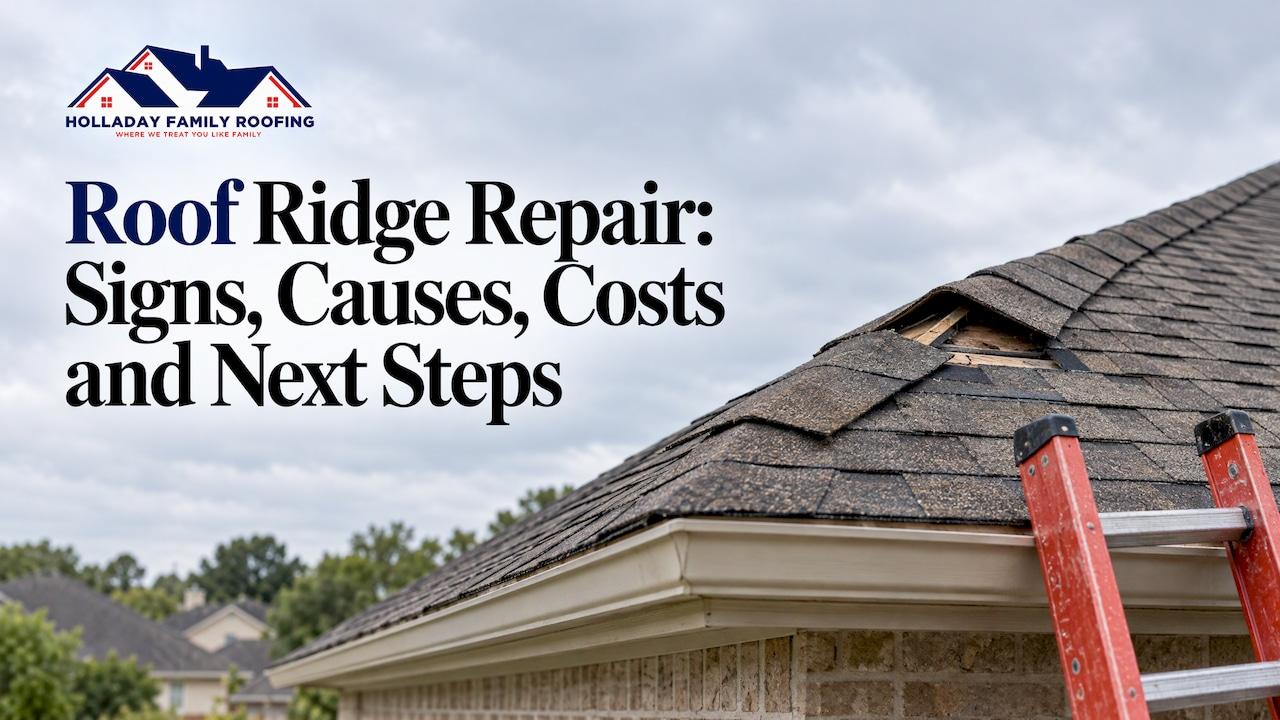
Roof ridge repair means fixing or replacing the cap material that covers the peak where two roof slopes meet. On a typical asphalt shingle roof, a roofer removes the damaged or loose ridge cap shingles, checks the roof deck and underlayment underneath, and installs new caps with the right nails and sealant. Because the ridge sits at the highest, most wind-exposed point of your roof, a small problem there can turn into a leak quickly. The safest way to handle it is to spot the signs from the ground and have a roofer inspect it. Holladay Family Roofing offers free roof inspections for homeowners and commercial property owners in Houston, Pearland and Friendswood.
TL;DR
- The ridge is the horizontal line along the top of your roof. Its covering, the ridge cap, is made of special shingles or formed metal, and it is one of the first places a storm shows damage.
- Warning signs include missing, cracked or lifted caps, caps pulling away from the shingles below, and stains in the attic near the peak. You can check most of these from the ground.
- General U.S. cost figures for ridge cap work run from a few hundred dollars for a short ridge to a couple thousand dollars for a whole roof. Your own price depends on the roof, so it needs a project-specific estimate.
- Do not climb a damaged roof, and do not poke at a sagging or stained ceiling. Photograph what you can see safely and call a professional.
- If a storm caused the damage, document it before repairs and read your policy. We can help you through the insurance claim process.
Table of Contents
- What the ridge and ridge cap are
- Signs your ridge needs repair
- What damages ridge caps
- Repair or replace: how to tell
- What roof ridge repair costs
- Why a handyman patch or a quick dab of sealant falls short
- If a storm did it: documenting and insurance
- Having the ridge repaired: what to ask
- Let us look at your ridge
- FAQ
- Sources
What the ridge and ridge cap are
The ridge is the roof's highest horizontal line, where opposing slopes meet. Its visible covering is the ridge cap, made of special shingles or formed metal. Hips, the sloped lines where two roof planes meet at an outside corner, are usually capped the same way.
The cap matters because the ridge is not shielded by another course of shingles above it. According to one roof inspection guide, a displaced cap can expose openings directly to rain and wind-driven precipitation. Those openings may include nail holes, a ridge-vent slot or the joint in the roof sheathing, which is the wood deck under your shingles.
So a ridge cap is a small part of the roof that does a big job. When it fails, water does not have to travel far to reach your attic.
Signs your ridge needs repair
Start with the ground. Stand in the yard or across the street in daylight, and look along the top of the roof. If you have binoculars, use them. You are looking for:
- Missing caps. A gap in the line of the ridge, or a bare section where the dark cap shingles should be.
- Lifted or curled caps. Caps that stick up or pull away from the shingles beneath them. Lifted caps and caps pulling away from field shingles are common failures, as are damaged ridge vents that let water in.
- Cracked caps. Cold or excessive bending can crack caps, and cracked shingles absorb more water.
- A wavy or uneven ridge line. This can point to a problem with the deck or framing under the cap, which a roofer needs to evaluate.
- Shingle granules or debris collecting in gutters or on the ground beneath the peak after a storm.
Inside the house, the clues are subtler. One ridge cap guide lists damp attic insulation, stained sheathing near the peak and ceiling stains beneath vaulted ceilings as possible ridge-leak signs. It also notes that condensation can resemble a leak, which is one reason a trained eye helps. In Houston's humid climate, moisture in an attic is not always a roof leak, and a roofer can tell the difference.
Safety first
Ground-level observation is enough for you. Please do not:
- Climb onto a roof you think is damaged. Ridges are steep, high and slick after rain.
- Push on or puncture a sagging or bulging ceiling to release water. Leave that to a professional.
- Work in an attic or near wiring when it is wet. Water and electrical hazards do not mix, so keep clear of light fixtures, junction boxes and wires near a leak.
If water is actively coming in, move belongings out of the way, put a bucket under the drip, and take photos from a safe spot.
What damages ridge caps
Wind. Wind blow-offs due to inadequate nailing are the most common ridge or hip-covering failure across roofing materials. Houston-area homes face seasonal thunderstorms and tropical weather, and ridges take the full force of it. Caps that were nailed short, nailed in the wrong place or sealed poorly can lift in a strong gust.

Bending and cracking. Caps are bent over the peak when installed. Over years of heat and cold, the material gets brittle and can crack along the fold.
Age. Ridge caps age with the rest of the shingles. If the field shingles on your roof are curling, losing granules or breaking, the caps are usually in similar shape, and a patch may only buy a little time.
Poor installation. Too few nails, nails that are not driven properly, or caps cut from the wrong shingle can fail early.
Ridge vents. On roofs with a ridge vent, the cap covers a slot that lets attic air escape. If the cap shifts, that slot can admit water.
Repair or replace: how to tell
A ridge repair makes sense when the damage is limited: a handful of lifted, cracked or missing caps on an otherwise sound roof. The roofer removes the bad caps, checks the deck and underlayment beneath, and installs new ones secured to manufacturer specifications.
Full ridge cap replacement, sometimes called roof ridge replacement, is the better call when:
- Damage runs along much of the ridge or across several hips.
- Caps are brittle and break when touched, so patching just moves the problem down the line.
- The deck under the caps is soft or stained, which means water has been getting in for a while.
- The roof is near the end of its life. In that case, ridge work may be better folded into a roof replacement than repeated as small fixes.
On a shingle roof, new caps are typically cut from matching shingles or made from purpose-built cap shingles. The National Roofing Contractors Association (NRCA) lists ridge-cap shingles and sheet-metal ridge-cap flashing among the components covered in its roof repair manuals, and says its asphalt-shingle repair manual gives step-by-step procedures with photo illustrations drawn from experienced contractors and manufacturers. If your roof is asphalt shingle, our asphalt shingle roofing page explains what we install.
Tile and slate roofs
Tile and slate ridges work differently. The Tile Roofing Industry Alliance says concrete and clay tile roofs are generally repairable by replacing individual damaged tiles, subject to inspection of the whole system. The same guide says the underlayment usually acts as a secondary water barrier and advises against putting new or reused tiles over compromised underlayment. It also says trained professionals should evaluate repair options and inspect the underlayment and decking. For slate, the Slate Roofing Contractors Association's 2025 repair guide says defective slates in ridges and hips should be removed and replaced, and recommends concealed fasteners for replacement ridge metal where possible, with any exposed screw or nail heads gasketed.
The takeaway: on tile and slate, the visible ridge piece is only part of the job. The layers underneath decide whether the repair holds.

Metal roofs
Metal roofs use formed ridge caps fastened over the peak. Damage there usually comes from loose fasteners, worn sealant or impact. If you have or are considering a metal roof, see our metal roofing page.
What roof ridge repair costs
Only a roofer who has seen your roof can give you a price. For a general idea, a 2026 U.S. ridge cap cost calculator based on contractor survey data gives these installed ranges for hip-and-ridge shingle work:
| Job size | Typical installed range |
|---|---|
| Short ridge, 10 to 20 linear feet | $285 to $400 |
| Standard residential ridge, 40 to 80 linear feet | $560 to $1,100 |
| Whole-roof package, 80 to 150 linear feet | $1,100 to $2,300 |
The same calculator puts the cap material alone at $4.50 to $6.00 per linear foot and a vented ridge at about $6.50 more per linear foot. These are national averages for planning, not a quote for a Houston-area home. They are not a Holladay Family Roofing price.
What moves your actual price:
- Length of ridge and number of hips. More linear feet means more material and labor.
- Roof pitch and height. Steep, tall roofs take more time and safety equipment.
- Material. Shingle, metal, tile and slate caps cost very different amounts.
- Ridge vent. A vented ridge adds material and work.
- Condition underneath. If the deck is wet or rotted, that must be repaired too.
- Access and roof layout. Multiple levels and dormers add complexity.
We do not publish set prices for ridge work. A free estimate, based on your actual roof, is the way to get a number you can plan around. An estimate request is not a booking and not a price quote; the roofer still needs to inspect the roof before pricing the work.
Why a handyman patch or a quick dab of sealant falls short
People often ask whether a handyman can repair a roof. Small cosmetic jobs may be within a handyman's range, but ridge damage is rarely just cosmetic. The ridge covers the roof's most exposed seam, and the right fix depends on what is under the cap: nail placement, deck condition, ventilation and underlayment. A tube of sealant over a cracked cap hides the crack without addressing why it cracked or lifted, and it can trap water.
A roofing contractor can check the whole ridge line, not just the one spot you noticed, and tell you whether neighboring caps are about to fail. On a steep roof, a professional also brings the fall protection and training that a weekend repair does not.
If a storm did it: documenting and insurance
Many ridge problems in the Houston area follow a wind event. If you think a storm damaged your ridge, a few steps protect your options:
- Photograph from the ground. Capture the ridge line, any visible missing or lifted caps, and debris in the yard. Inside, photograph stains or drips. One storm damage guide advises photographing exterior and interior damage, keeping receipts for emergency repairs and recording storm evidence.
- Keep older photos. The same guide recommends documenting the roof's pre-storm condition where you can, which helps distinguish storm damage from pre-existing wear. Real estate listing photos or past inspection reports sometimes work.
- Limit repairs to what is needed to stop further damage. Keep every receipt.
- Read your policy and call your insurer. Check your deductible and what your policy says about wind and hail. Coverage depends on your policy and the cause of damage. Nobody can promise a claim will be approved.
- Ask questions of the right office. If you have questions about your rights as a Texas policyholder, the Texas Department of Insurance, the state's insurance regulator, is the place for them.
Holladay Family Roofing has experience helping homeowners navigate insurance claims, and a roofer's inspection findings and photos can give you something concrete to bring to the conversation with your insurer.
Having the ridge repaired: what to ask
Whoever you hire, get the plan in writing. Useful things to ask about:
- How the caps will be fastened and what material will be used.
- Whether the roofer will check the deck and underlayment under the damaged section.
- Whether the ridge vent, if you have one, will be inspected or replaced.
- How the roofer will handle surprises, like rotted decking, and how that is priced.
- What the written warranty covers, for how long, and what it excludes.
We offer a ten-year no-leak warranty. Warranty coverage is project-specific, so read the written terms for your job to see exactly what applies. For commercial buildings with flat or low-slope roofs, where the ridge is not the issue but leaks are, see our guide to commercial roof leak repair. If the stain you found is near a pipe vent rather than the peak, our guide to roof boot repair covers that common leak source.
Let us look at your ridge
Holladay Family Roofing has served Houston for over 20 years in residential and commercial roofing, with a family-first approach. We handle roof repair and replacement, and we offer free estimates and free roof inspections. If your ridge caps are lifted, cracked or missing, we can look at the ridge, the roof around it and what is underneath, then explain whether a repair or a larger fix is the better choice for your roof.

Our verified primary service areas are Houston, Pearland and Friendswood. If you are outside those areas, please confirm availability with us first. To get started, request a free estimate or call (832) 883-3930.
FAQ
How much does it cost to replace a roof ridge?
General U.S. figures for installed ridge cap shingles range from about $285 to $400 for a short ridge to $1,100 to $2,300 for a whole-roof ridge and hip package, according to a 2026 cost calculator. Your price depends on ridge length, roof pitch, material, vents and the condition of the deck. A free estimate based on your roof is the way to get a project-specific number.
What does a ridge look like on a roof?
It is the horizontal line along the very top of the roof, where two slopes meet. On shingle roofs it is covered by a row of slightly thicker cap shingles, and on metal roofs by a formed metal cap. Hips, the angled lines at outside corners, are capped similarly.
Can a leaking ridge cap cause damage inside my home?
Yes. A missing, cracked or lifted cap can expose nail holes, a vent slot or the sheathing joint to water, which can wet attic insulation and stain ceilings. Stains can also come from condensation, so have a roofer inspect before assuming the cause. Do not climb up or poke at a sagging ceiling yourself.
Can I fix a ridge cap myself?
We do not recommend it. The ridge is the highest and steepest point of the roof, and the right repair depends on what is under the cap. A professional inspection from the ground and roof can catch hidden deck or underlayment damage that a quick patch would miss.
Sources
- Parts of a Roof: Complete Diagram + Glossary
- Roof Ridge Cap: Types, Installation Issues, and Leak Signs
- Ridge & Hip Cap Shingles
- Roof repair expertise, National Roofing Contractors Association
- Post Storm Event: Considerations for Repairing Damaged Concrete and Clay Roofing Tiles
- Slate Roof Repair, Restoration, and Maintenance Level 1
- Ridge Cap Cost Calculator (2026)
- Storm Damage Roof Repair guide, 2026