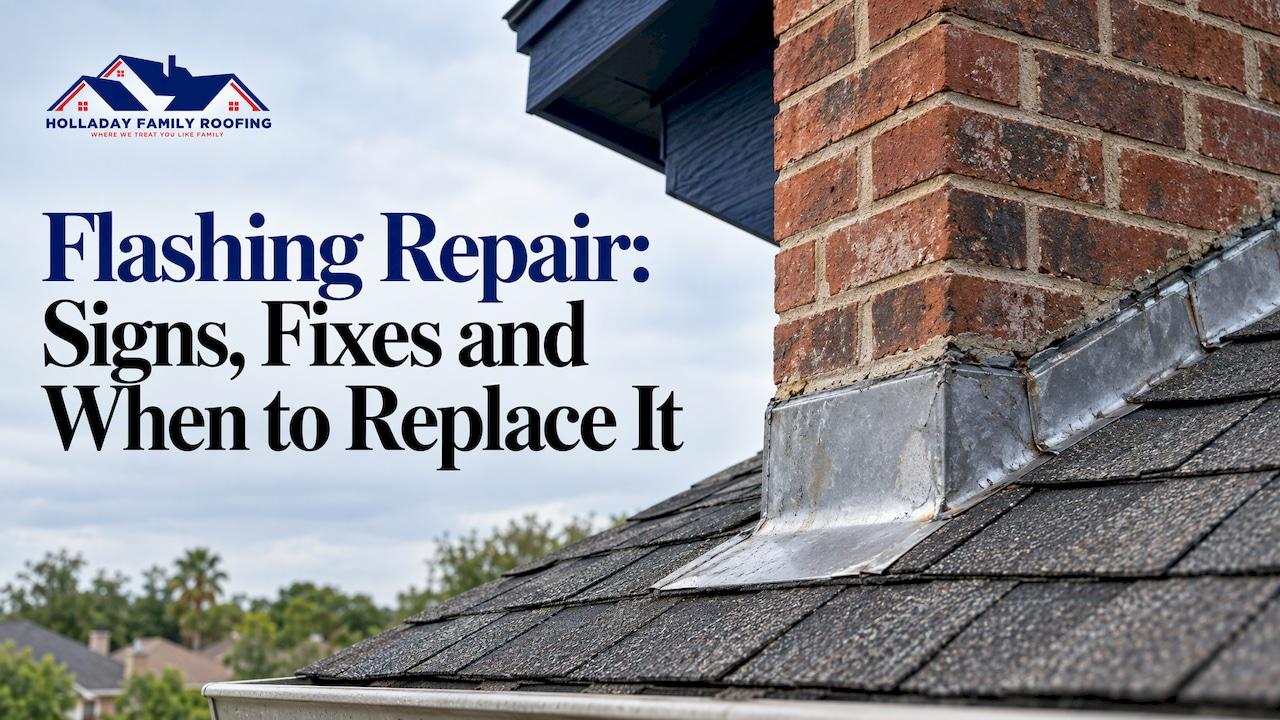
Flashing repair means fixing or replacing the thin metal strips that seal the places where your roof meets something else: a chimney, a wall, a vent pipe, a skylight or a valley. If the metal is only loose or a small joint has opened, a repair can stop the leak. If it is rusted, bent, split or pulled away, the piece needs to be replaced. Either way, it is work done on the roof, so it belongs with a roofer rather than a ladder. Holladay Family Roofing offers roof repair and a free roof inspection in Houston, Pearland and Friendswood, so a trained eye can tell you which of the two you need.
TL;DR
- Flashing is the metal that keeps water out where the roof meets a chimney, wall, vent, skylight or valley. When it fails, water gets under the shingles.
- Repair fits isolated damage on otherwise sound metal. Replacement fits rust, corrosion, splits, bends or pieces that have pulled away.
- Caulk over a failing joint is a temporary patch, not a lasting fix, and chimney flashing in particular is a job for a professional.
- Cost depends on the type of flashing, the roof height and pitch, and what is hidden underneath. Only a project-specific estimate gives you your number.
- Do not climb a damaged roof to look for the source. Watch from the ground and the attic floor, then call a roofer.
Table of Contents
- What flashing does and why leaks start there
- The main types of flashing on a Houston roof
- Signs your flashing needs repair
- Why flashing fails
- Repair or replace: how to tell
- Why caulk alone is not the answer
- How a professional repairs chimney flashing
- Why this is not a do-it-yourself job
- What affects the cost of flashing repair
- When flashing is a sign of a bigger roof problem
- Insurance and flashing leaks
- Have us look at your flashing
- Keeping flashing in good shape
- FAQ
- Sources
What flashing does and why leaks start there
Shingles shed water well on a flat, unbroken slope. The trouble starts wherever that slope is interrupted. A chimney, a plumbing vent, a skylight or a wall that rises above the roof all create a seam, and water will find any seam it can. Flashing is the metal that bridges those seams. As This Old House explains, it creates a watertight seal around roof penetrations and transitions, and when it is installed incorrectly water can seep under the shingles and lead to water damage, mold and a weakened structure.
The U.S. Department of Energy's building science education site makes the same point from the house's side: penetrations are among the most vulnerable spots for water intrusion, and leaks through them can quickly damage insulation, invite mold and pests, and lead to structural rot.
That is why flashing leaks are so often misread. The stain on your ceiling may sit several feet from the actual failure, because water travels along the deck and framing before it shows itself.
The main types of flashing on a Houston roof
You do not need to learn roofing vocabulary, but a few names help when you read an estimate.
- Step flashing: small L-shaped pieces layered with each shingle course where a roof meets a vertical wall, such as a dormer or a second-story wall.
- Chimney flashing: usually two parts. Base flashing sits on the roof deck, and a cap (or counter) flashing is set into the masonry above it.
- Valley flashing: the metal channel where two roof slopes meet and carry a lot of water.
- Pipe boots and vent flashing: collars around plumbing vents and exhaust pipes. The rubber part tends to crack in the sun. We cover this separate problem in our guide to roof boot repair.
- Skylight flashing: a kit that wraps the frame on all four sides.
- Drip edge: metal along the eaves and rakes that guides water into the gutters.
Signs your flashing needs repair
Most of the clues can be seen from the ground, from inside the house or in your attic doorway. None requires you to step onto the roof.
Inside the house
- Brown or yellow water stains on a ceiling or wall near a chimney, an exterior wall corner or a vent.
- Stains that grow after heavy rain and dry out between storms.
- Peeling paint or bubbling drywall along an exterior wall below a roof-to-wall joint.
- A musty smell in the attic or upper rooms.
From the yard
- Visible gaps, lifted edges or dark streaks of rust on metal around the chimney.
- Dried, cracked or peeling sealant lines around a chimney or vent.
- Shingles curling or missing right next to a penetration.
- Metal that is bent, dented or hanging away from the wall.
In the attic
- Dark, damp rings or water trails on the decking around a chimney or pipe.
- Wet insulation or rusty nail tips on the underside of the deck.
A small pair of binoculars from a safe spot in the yard shows a lot. If you see any of the above, take photos with the date on them. They help your roofer and, if you file a claim, your insurer.
Why flashing fails
Flashing rarely fails for just one reason. The American Society of Home Inspectors lists the common causes of chimney flashing failure: rust from age, failed paint or mixed incompatible metals, damage from animals, movement between the roof and the chimney, deteriorating mortar or fasteners, nearby work, and installation mistakes.
In the Houston area, heat, humidity, heavy downpours and storm winds work against the metal and the sealant all year. A sealant bead that looked fine five years ago can dry out and split. Fasteners loosen. Metal that was never properly lapped begins to let water in at the first strong storm.
What happens next matters more than the cause. The water runs down the flashing joint, soaks the roof sheathing and moves along the framing. A water damage restoration guide notes that mold can begin to develop within a day or two on damp wood and drywall. If you already see dark spots or smell mustiness, read our guide on mold from a roof leak for what to do and who to call.
Repair or replace: how to tell
This is the question that decides your price and how long the fix lasts.
| Condition of the flashing | Usual answer |
|---|---|
| Isolated damage, metal otherwise sound | Repair: refasten a loose piece, reseal a single joint, swap a cracked boot |
| Rusted through or heavily corroded | Replace |
| Split along a fold | Replace |
| Bent, or pulled away from the wall or chimney | Replace |
| Missing pieces | Replace |
| Counterflashing pulled out of chimney mortar | Professional repair or replacement |
| Old flashing found during a full re-roof | Inspect everything and replace what is damaged or poor |
The EPA-backed Building America Solution Center recommends that when older roofing is replaced, all flashing at penetrations, roof-wall joints and valleys be inspected, and any missing, damaged or poorly installed flashing be repaired or replaced. That is the practical rule behind a re-roof: you are already paying to have the shingles off, so the flashing underneath is the cheapest it will ever be to renew.
For homeowners, the takeaway is simple. A small, clean repair makes sense on sound metal. Once corrosion or deformation is present, repeated patching just delays the bill and lets the water keep working.

Why caulk alone is not the answer
A tube of sealant is the first thing most people reach for, and it is the reason many flashing leaks come back. Home inspectors treat caulked cap-flashing joints as a temporary maintenance situation, not a permanent solution, according to the ASHI chimney flashing article. The reason is movement. A chimney and a roof expand, contract and settle at different rates, and a rigid bead of sealant cannot absorb that.
The proper design lets the two parts of the chimney flashing overlap. The base flashing is secured to the roof deck, the cap flashing is secured into the masonry, and the overlap absorbs movement without breaking the seal. A sealant smeared across the top hides the problem and eventually cracks.
How a professional repairs chimney flashing
Chimney flashing is the most common and most demanding case, so it is worth knowing what a correct job involves. The steps below describe the work a roofer does, not a project for you to attempt.
- Find the source. The roofer checks the flashing, the surrounding shingles, the mortar joints and the chimney itself, because several of them can leak at once.
- Remove the damaged material. Shingles next to the chimney are lifted, and the old flashing is taken off in pieces so the deck underneath can be examined.
- Repair the deck if needed. Soft or stained wood is a sign the leak has been going on a while and may need replacing before new metal goes on.
- Install new base flashing. Pieces are layered with the shingles so that water always runs over the metal, never behind it.
- Add or check the cricket. A cricket, also called a saddle, is a small peaked structure behind the chimney that sends water around it. The ASHI article notes many authorities require one when the chimney is wider than 30 inches, and that without a cricket the top flashing should climb at least one-sixth of the chimney's width, with a 6-inch minimum.
- Set the counterflashing. It is secured into the masonry, usually by cutting a slot into a mortar joint, and sealed there, rather than just coated with sealant.
- Re-shingle and check the finished seams.
That masonry cut is one reason chimney work is not a casual repair. A mistake can leave the chimney, not just the roof, damaged.
Why this is not a do-it-yourself job
Many pages on this topic offer a weekend method. We would steer you away from it for three reasons.
Falls are the real risk. Roof work is hazardous even when the roof is dry and low. Wet, steep or damaged roofs are worse, and a leaking roof is by definition wet or weakened. Do not climb up to trace a leak, do not poke at a stained or sagging ceiling to see what is behind it, and stay clear of anything near power lines or service drops. Water and electricity together are a danger you cannot see.
The fix is hidden. Real flashing repair means lifting shingles, working under them and putting everything back in order. Done wrong, it can leave a leak that is harder to find than the first one.
A bad repair can cost you later. Misplaced sealant or metal can trap water and rot the deck for years before a stain shows up.
If you are comfortable with one thing, let it be this: photograph what you see from the ground, put a bucket under any drip, move belongings out of the way, and call a roofer. For fast steps on an active leak, see our guide to emergency roof repair in Houston.

What affects the cost of flashing repair
You will find price ranges all over the web, and they vary widely because flashing jobs vary widely. Published figures are general, national or regional ranges, so use them only to get a rough feel. Your own number comes from a written, project-specific estimate after someone looks at your roof.
The factors that move the price most are:
- Type of flashing. A pipe boot is a small job. A chimney, a long run of step flashing or a valley is much bigger.
- Repair or full replacement. Resealing or refastening a piece costs far less than rebuilding the entire flashing system around a chimney.
- Roof height and pitch. Two-story homes and steep slopes take more time and more safety equipment.
- Roofing material. Shingle, tile and metal roofs each need different handling around flashing.
- Hidden damage. Wet insulation, rotted decking or mold behind the flashing add work.
- Access and extent. One chimney is not the same as flashing on every wall and dormer.
- Timing. Flashing replaced during a re-roof is usually simpler than a standalone repair done later.
A fair estimate should name which flashing is being repaired or replaced, what material will be used and what is included. Ask for that in writing.
When flashing is a sign of a bigger roof problem
Sometimes the flashing is only the first thing to fail. If the shingles around it are curling, granule-bare or lifting across the whole slope, a patch at the chimney will not save the roof. In that case, a roofer may suggest looking at roof replacement, and fresh flashing goes in as part of that work. Homes with metal roofs have their own flashing details, which our metal roofing page covers, and commercial flat roofs are a different case again. For those, see our article on commercial roof leak repair.
Insurance and flashing leaks
Whether a flashing leak is covered depends on your policy and on what caused the damage. A storm that tore metal away is a different situation from flashing that wore out over the years. Your policy and your insurer decide coverage, and we cannot promise it. What helps in either case is documentation: dated photos, a written description of the problem and a roofer's report. Holladay Family Roofing helps homeowners work through insurance claims, so you do not have to sort out the paperwork alone. Read your policy's wording on wind, hail and water damage, and contact your insurer directly with questions about your coverage.
Have us look at your flashing
At Holladay Family Roofing, we have been roofing in Houston for over 20 years, for homes and commercial buildings. We offer free estimates and free roof inspections, and our work comes with a ten-year no-leak warranty. Warranty terms are specific to each project, so we ask you to read the written terms for your job before you sign.
A free inspection is a good place to start if you see a stain, a rusty joint or a gap and do not know what it means. We can tell you whether the flashing needs a repair or a replacement, and whether the roof around it is sound. See our roof repair page for the services we offer, or request a free estimate. We serve Houston, Pearland and Friendswood. If you live elsewhere, please contact us to confirm we can come to you.

Keeping flashing in good shape
A little attention goes a long way.
- Look at your flashing from the ground after big storms. Binoculars help.
- Keep gutters clean so water does not back up at roof edges and valleys.
- Trim branches that rub on or drop debris against the roof.
- Have your roof inspected on a regular schedule and after severe weather.
- Fix small gaps early, before water reaches the deck.
- When you replace the roof, have the flashing replaced with it.
FAQ
Can I repair roof flashing myself?
We do not recommend it. The work means lifting shingles on a roof, often a wet or steep one, and chimney work includes cutting into masonry. A poor repair can hide a leak and let it rot the deck. Photograph what you see from the ground and call a roofer.
How long does a flashing repair last?
It depends on the fix. A sealant-only patch is a temporary measure. Properly installed, integrated flashing is built to last much longer, and the roofer should be able to tell you what to expect for your roof. Ask for the work and the warranty terms in writing.
Is a leaking chimney always a flashing problem?
No. Cracked mortar, a damaged chimney crown, a missing cricket or failing shingles nearby can leak too, and sometimes several at once. A roofer checks the whole area. That is why a stain near the chimney should be inspected rather than just resealed.
How much does flashing repair cost?
Published ranges are general and vary a lot by region, roof type and the kind of flashing. A small repair costs much less than replacing the flashing around a chimney. Only a written, project-specific estimate gives your price, and an estimate request is not a price quote or a booking.
Does flashing repair need a full roof replacement?
Not always. If the shingles and deck are in good shape, flashing can often be repaired or replaced on its own. If the roof is near the end of its life, replacing it and its flashing together is usually the more sensible plan.
Sources
- What Is Roof Flashing? (This Old House)
- Sealing Penetrations (U.S. Department of Energy, Building Science Education)
- Chimney Flashings (American Society of Home Inspectors)
- Flashing of Penetrations in Existing Roofs (Building America Solution Center)
- Why Does Chimney Flashing Fail and Cause Leaks?