
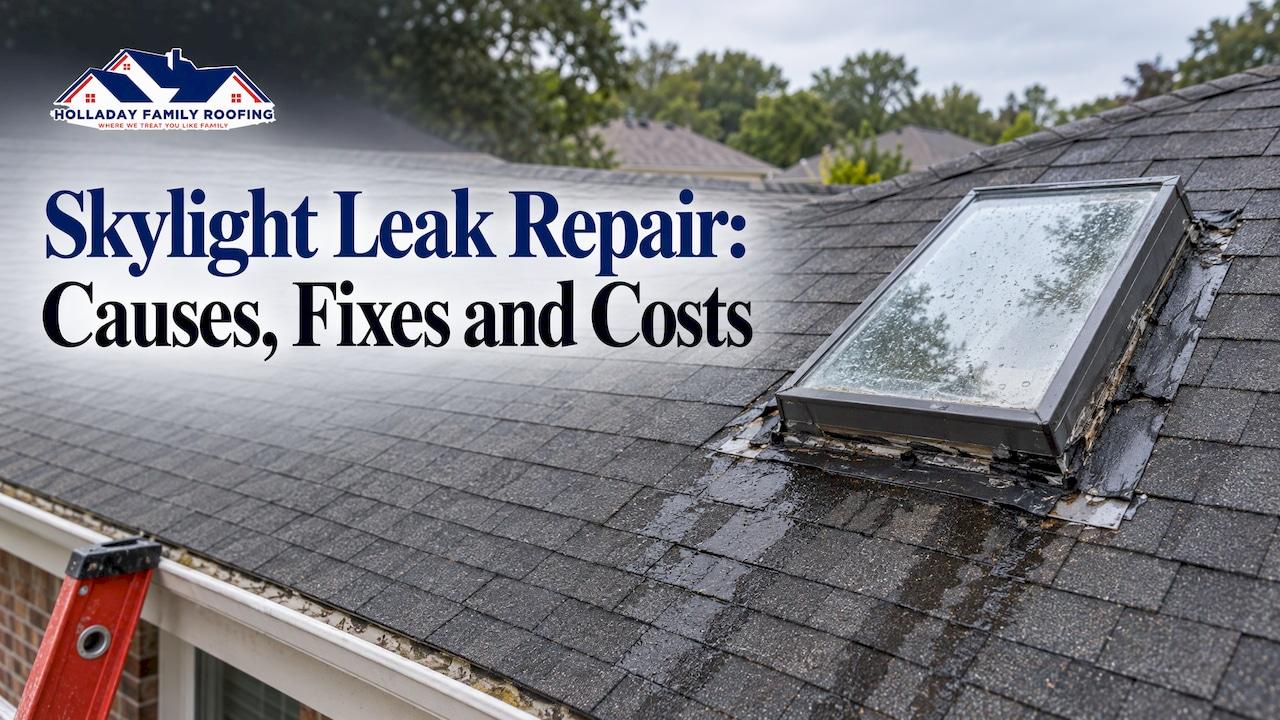
Most leaking skylights can be repaired, and the fix is usually at the flashing (the metal and membrane that seal the skylight to the roof) or at a worn seal, not in the glass itself. The right repair depends on where the water gets in. That means the work starts with finding the real source, which is often higher up the roof than the stain on your ceiling. At Holladay Family Roofing, roof repair for skylight leaks starts with a free roof inspection so the repair matches the cause.
TL;DR
- Skylight leaks usually come from failed flashing, worn weatherstripping or gaskets, or an aging unit. Condensation can look like a leak but has a different fix.
- Water travels along rafters and decking before it drips, so the stain is not always under the leak.
- From the ground and inside, you can watch, photograph and protect your floor. Leave the roof, the ceiling and the electrical work to professionals.
- One 2026 cost guide puts skylight leak repair at $225 to $900, with flashing fixes more common than full replacement. Your own price comes from a written estimate.
- Insurance generally responds to sudden damage from a covered event such as hail, not to a seal that wore out with age.
Table of Contents
- Why skylights leak in the first place
- Is it a leak or condensation?
- What you can safely do yourself
- How a roofer repairs a leaking skylight
- Repair or replace the skylight?
- What skylight leak repair costs
- Does homeowners insurance cover a leaking skylight?
- Fixing the skylight with Holladay Family Roofing
- FAQ
- Sources
Why skylights leak in the first place
A skylight is a hole cut through the part of your roof that keeps water out. The U.S. Department of Energy's Building America Solution Center explains that skylights are penetrations through the roof's water control layer. When components weather or the installation was not done well, that spot becomes a weak point where water can reach the attic and do significant damage over time.
In practice, the usual suspects are:
- Flashing problems. Flashing is the layered metal and waterproof membrane that surrounds the skylight and tucks under the shingles. Gaps, lifted edges, rust or old sealant that has cracked let water run behind it. Lowe's repair guide lists holes around the flashing as a common cause.
- Worn weatherstripping or gaskets. The rubber seals around the sash (the movable or glazed part) harden and shrink with sun and heat. This is especially relevant for opening skylights.
- An aging unit. Older skylights eventually fail at the frame joints or the sealed glass unit.
- Roof problems nearby. Damaged shingles or underlayment (the waterproof layer under the shingles) around the skylight can send water into the opening even when the skylight itself is fine.
The Department of Energy's Building Science Education Center calls skylights among the most common sources of water infiltration in a home and recommends inspecting them whenever roof work is done. That is a good habit for any Houston-area roof, since our heavy rain tests every seal on the roof.
Is it a leak or condensation?
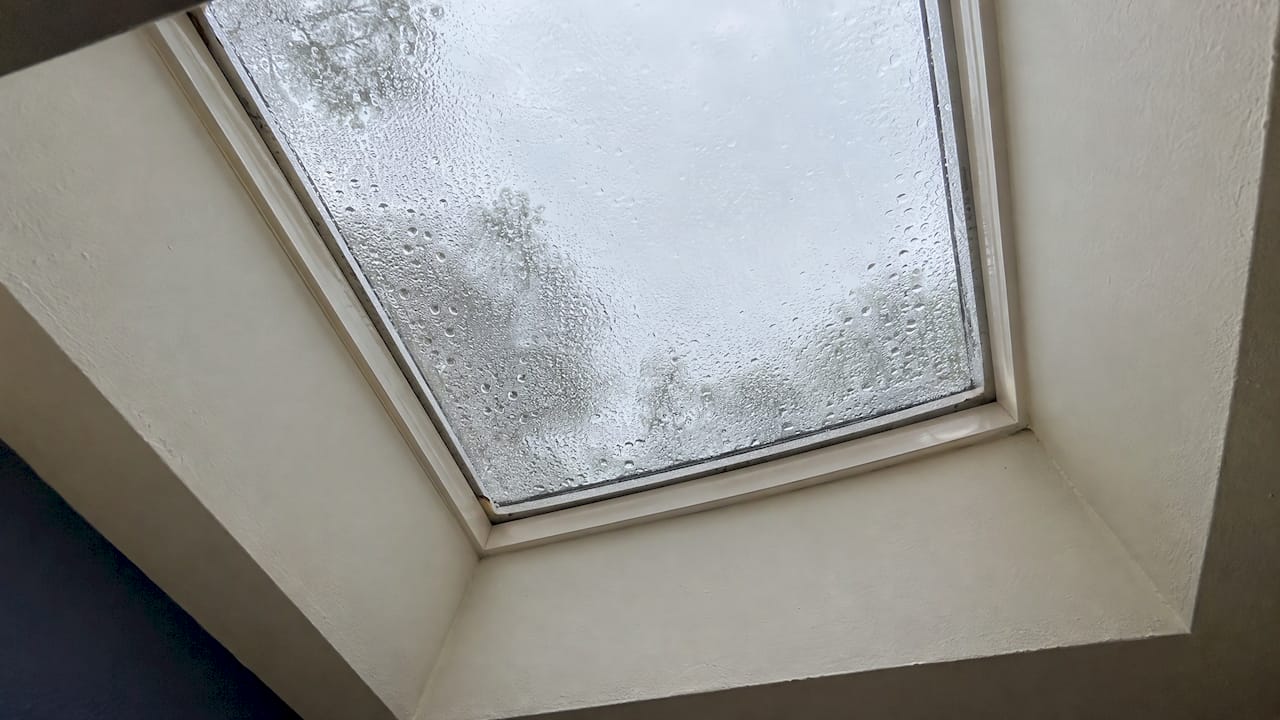
Before you pay for a repair, make sure water is actually coming in from outside. Condensation forms when warm, humid indoor air meets a cold glass surface. Lowe's notes that this is common in bathrooms and laundry rooms, where ventilation, exhaust fans or a dehumidifier can help.
Some clues point one way or the other:
- Timing. Drips that show up during or just after rain suggest a leak. Moisture that appears on cool mornings or after showers suggests condensation.
- Location. Water running down the inside of the glass or collecting in the frame's tray is often condensation. Stains on the drywall around the light well, on the ceiling nearby or on framing in the attic point to a leak.
- Moisture between panes. The American Society of Home Inspectors says sealed double- or triple-glazed units should never show condensation between the panes. If they do, the sealed glass unit has failed. Vented and drained skylights, by contrast, may fog from time to time.
A stain on the ceiling is also not proof of where the leak starts. Water follows rafters, decking and insulation before it drips. That is why a stain across the room from the skylight can still trace back to it, and why a stain beside the skylight can come from somewhere else on the roof.
What you can safely do yourself
Do not climb onto the roof to look for the leak. Wet shingles, a steep pitch and an unfamiliar roof surface are a bad mix, and a damaged roof deck may not hold your weight. Do not poke or cut into a sagging or bulging ceiling to drain it, and keep clear of any light fixtures, wiring or outlets near wet areas.
From the ground and from inside, these steps are reasonable:
- Protect the room. Move furniture and rugs, and set a bucket under any drip. Place a tarp or plastic sheet on the floor.
- Photograph everything. Take dated photos and short video of the stain, the skylight, and the weather. You will want them for a roofer and, if the damage was sudden, for your insurer.
- Look from the ground. With binoculars, check for lifted or missing shingles, visible gaps around the skylight, or debris piled against it.
- Watch the pattern. Note whether it leaks only in wind-driven rain, only in heavy rain, or even in light rain. Wind-driven leaks often point to flashing at the sides or top.
- Check for active moisture. ASHI notes that a pin-less moisture meter can show whether a problem is active: a wet reading means active, while a dry one is inconclusive.
You may see guides that suggest spraying the roof with a garden hose to find the leak. The Pacific Northwest National Laboratory's guidance warns that too much volume or velocity, or spraying upward at seals that are normally shielded, can create leaks that would not happen in normal weather. It says this testing is not recommended for most homeowners. Leave it to a roofer who does it as part of an inspection.
The same goes for caulk. Home inspectors describe roofing cement or caulk on a skylight as a temporary repair at best. A bead of sealant can hide the entry point while water keeps traveling underneath, which makes the real source harder to find later.
How a roofer repairs a leaking skylight
A proper repair follows the leak to its cause. Here is how the work typically goes.
Inspection from above and below
A roofer checks the roof surface around the skylight, the flashing on all four sides, the condition of the shingles and underlayment, and the seals and frame of the unit. Inside, they look at the attic framing and the light well for stains, wet insulation or daylight where it should not be. The Department of Energy's inspection guidance lists the same areas: peeling interior paint, stained framing, shingle and underlayment condition, and leakage through the unit or between frame and sash.
Reflashing
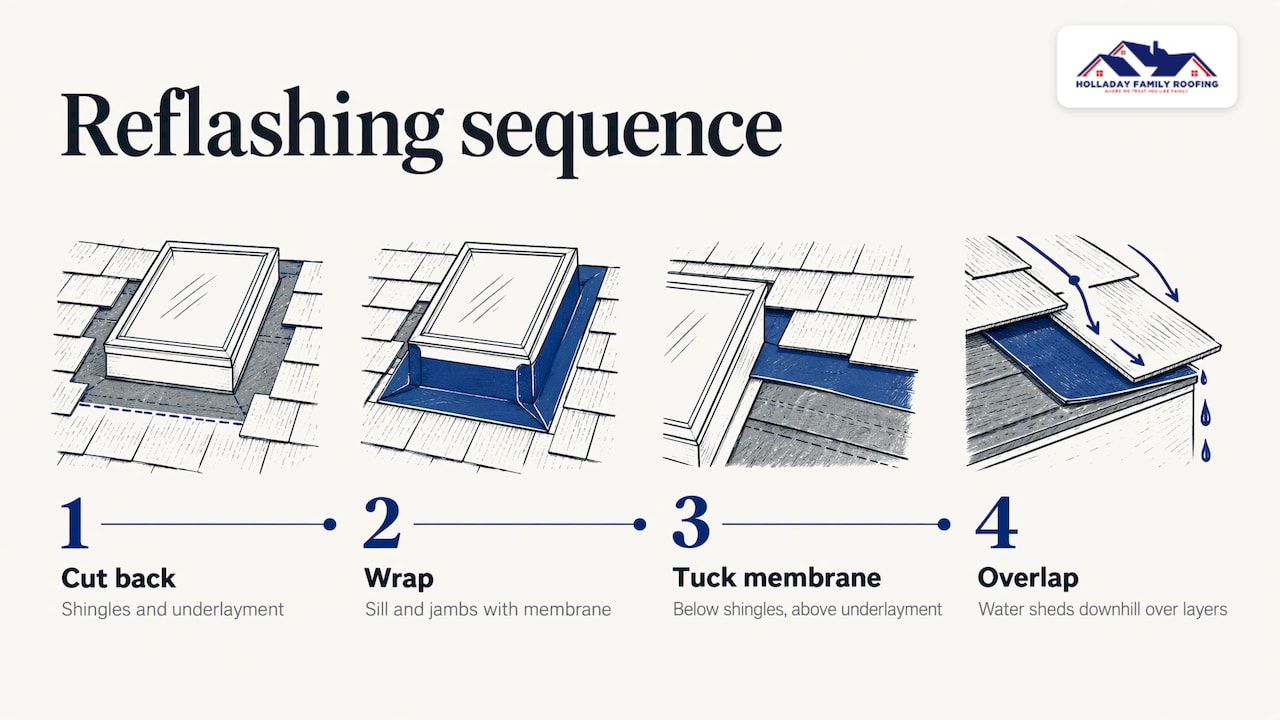
When the flashing has failed, the durable fix is to rebuild it, not smear sealant over it. For a curb-mounted skylight (one that sits on a raised frame), the Department of Energy describes cutting shingles and underlayment back from the curb, then wrapping the sill and jambs with self-adhered membrane flashing tucked below the shingles but above the underlayment. The layers overlap so that water always sheds downhill over the layer below. Getting that order right is where a rushed repair goes wrong, and it is hard to judge from the ground.
For related flashing problems elsewhere on your roof, see our guide to flashing repair.
Replacing seals, gaskets or the unit
If the leak comes from a worn gasket and a matching replacement exists, replacing it can solve the problem. The Building America Solution Center lists three situations that call for replacing the skylight itself: a failed insulated glass unit, leaks through the frame joints, and worn or missing gaskets on an operable unit when replacements are not available.
Repairing the shingles around it
Sometimes the skylight is sound and the shingles beside it are not. Cracked, lifted or missing shingles near the curb get repaired as part of the same visit. Our guide to shingle roof repair covers what can be fixed and when a larger job makes sense.
Repairing the inside
Once the roof is sealed and the area has dried, the water-stained drywall can be patched and painted. Wet insulation or lingering dampness should be dealt with first. If you see dark spots or smell mustiness, read our guide on mold from a roof leak. For the finish work on the ceiling afterward, a page on interior drywall patch repair shows how holes in a ceiling are repaired and refinished.
Repair or replace the skylight?
The cost of a repair is small next to the cost of repeated leaks, so the question is which fix will last.
| Situation | Usual direction |
|---|---|
| Flashing gaps, lifted edges or deteriorated sealant | Repair or reflash |
| Worn gasket with a replacement available | Repair |
| Moisture trapped between panes | Replace the glass unit or the skylight |
| Leaks at the frame joints | Replace the skylight |
| Skylight is old and the roof around it is near the end of its life | Replace it as part of roof work |
The last row matters. If your shingles are aging, a skylight repair may only buy time, and doing the skylight during a roof replacement lets the new flashing be built into the new roof layers. Our article on roof repair vs. replacement explains how to weigh the two.
What skylight leak repair costs
A published range is a starting point, not a price for your roof. One 2026 cost guide puts skylight leak repair at $225 to $900. It says $300 to $700 flashing fixes are far more common than full-unit replacement at $800 to $2,400. A skylight replacement guide from This Old House lists a cost of $400 and up and an estimated 2 to 4 hours for the job.
What moves the number on a real roof:
- How much flashing has to be rebuilt
- Roof pitch and how hard the roof is to reach
- Whether the shingles or decking around the skylight are damaged
- Whether the unit can be resealed or must be replaced
- How long water has been getting in and whether the interior needs work
At Holladay Family Roofing, estimates are free. An estimate is a written look at your specific roof and not a booking or a fixed price quoted over the phone. Compare it against the ranges above, but treat your own estimate as the number that counts.
Does homeowners insurance cover a leaking skylight?
Sometimes. Insurer Lemonade explains that a leaking skylight is generally covered when a covered peril such as hail, windstorm or a falling object caused it, and not when the seal wore out from age or lack of maintenance. Your policy language decides, so read it or ask your insurer how it treats wear and tear, deductibles and roof age.
If you think a storm caused the damage:
- Photograph the roof, the skylight and the interior damage, and record the date and the weather.
- Keep receipts for any temporary protection, such as a tarp.
- Get a written repair estimate.
- Report the loss to your insurer promptly. Texas policyholders can also contact the Texas Department of Insurance with questions about the claims process.
Holladay Family Roofing offers insurance claims assistance for homeowners. We can't promise a claim will be approved, because that decision belongs to your insurer.
Fixing the skylight with Holladay Family Roofing
Holladay Family Roofing has been roofing homes and commercial buildings in Houston for over 20 years, and our primary service areas are Houston, Pearland and Friendswood. A skylight leak call starts with a free inspection of the skylight, the flashing and the roof around it, so you learn what is failing before you decide on a repair. Our repairs come with a ten-year no-leak warranty. Ask for the written, project-specific warranty terms so you know exactly what a given job covers.

If the skylight sits in a roof that is due for replacement, we can also handle asphalt shingle roofing or metal roofing, and flat commercial roofs can be protected with roof coatings. If your building is outside Houston, Pearland or Friendswood, call to confirm availability.
FAQ
Can I fix a leaking skylight with caulk?
Caulk or roofing cement may slow a drip for a while, but home inspectors treat it as a temporary repair at best. It can also hide where the water is entering. A lasting fix usually means rebuilding the flashing or replacing a failed seal, which is roof work for a professional.
How do I know if my skylight is leaking or just has condensation?
Leaks tend to appear during or after rain and leave stains on the drywall, framing or ceiling. Condensation tends to show on cool mornings or in humid rooms and runs down the glass. Moisture between the panes of a sealed unit means the unit itself has failed.
How much does it cost to fix a leaky skylight?
One 2026 guide gives a general range of $225 to $900 for skylight leak repair, with replacement costing more. Your cost depends on the flashing, roof access and the condition of the unit. A free written estimate from Holladay Family Roofing gives the figure for your roof.
Is a leaking skylight an emergency?
Treat it as urgent, since water can soak insulation and framing quickly. Protect your floor, take photos and arrange an inspection soon. If water is near light fixtures or wiring, or the ceiling is sagging, stay out of that area and call a qualified professional. For first steps after storm damage, read our guide to emergency roof repair.
Will my insurance pay for it?
It may if sudden damage from a covered event caused the leak, but typically not when the seal simply wore out with age. Check your policy and report storm damage promptly.
To get your skylight looked at, request a free estimate or call (832) 883-3930.
Sources
- Existing Skylights Repaired or Replaced and Fully Flashed, Building America Solution Center
- Inspecting Skylights for Water Damage and Infiltration, Building Science Education Center
- Flashing around a Skylight without Roof Removal, Building Science Education Center
- Skylights, American Society of Home Inspectors
- How to Repair a Leaky Skylight, Lowe's
- How to Replace a Skylight, This Old House
- Roof Leak Repair Cost Guide 2026
- Does Homeowners Insurance Cover Roof Leaks?, Lemonade
- Pot Light Hole Repair, Sigma Painting