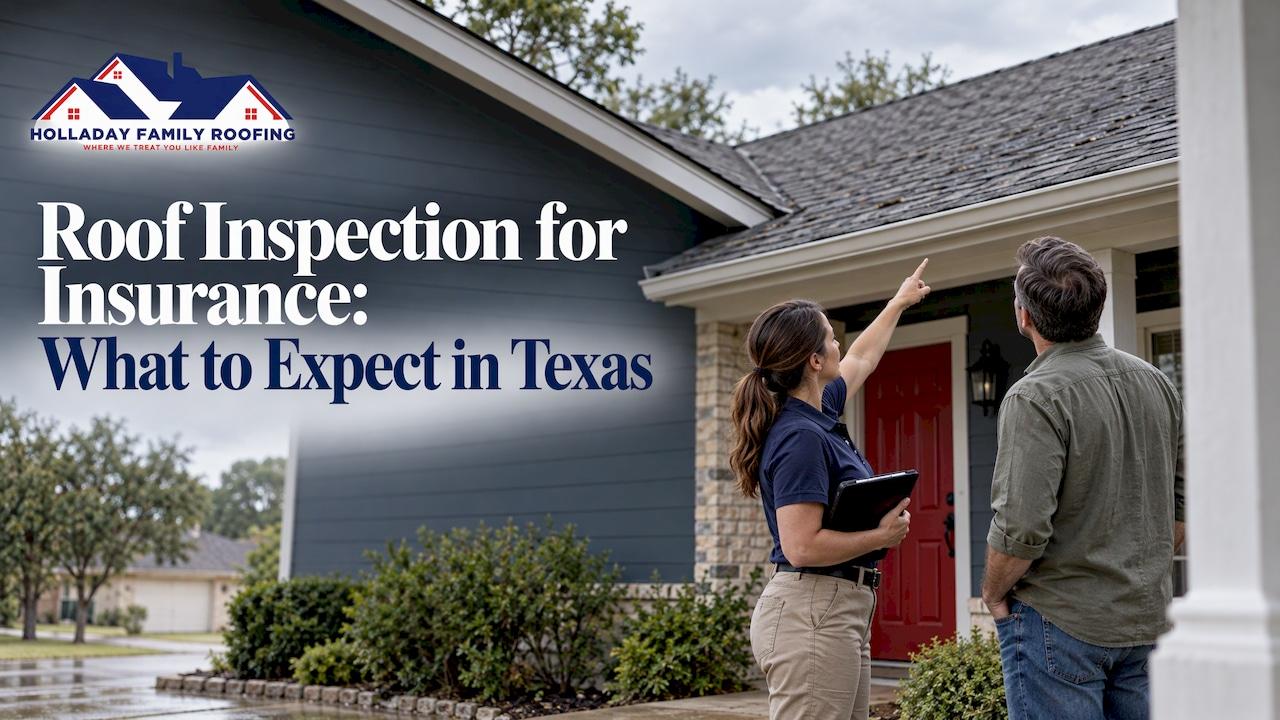
A roof inspection for insurance is a documented look at your roof's condition, done either by your insurer (when you apply for coverage or file a claim) or by a roofing contractor who records what is there so you can back up a claim. For a Houston-area homeowner, the strongest position is to have your own written, photo-backed inspection in hand before the adjuster arrives. Holladay Family Roofing offers a free roof inspection in Houston, Pearland and Friendswood, and can help you with the insurance claim process that follows.
This guide explains the three kinds of inspection you may run into, how to document storm damage without putting yourself at risk, what a good inspection report contains, and what happens to your claim after the inspection.
TL;DR
- Insurers inspect roofs at two moments: when you apply for or renew coverage, and after you file a claim. A contractor's inspection is a third, separate thing that you control.
- The adjuster documents damage, but your insurer decides what is covered. Policy terms, limits, deductible and the cause of loss drive the payout.
- Document from the ground, with dated photos and video. Never climb a damaged roof or poke at a sagging ceiling.
- Ask for a written inspection report with labeled photos, a stated cause for each finding, and a repair scope. You can usually have your own contractor present at the adjuster's visit.
- Read your policy for the wind and hail deductible and the replacement-cost deadline before you sign any repair contract.
Table of Contents
- The three inspections people mean by "roof inspection for insurance"
- What to do in the first days after a storm
- What a good roof inspection report includes
- How the inspection findings affect your claim
- If you disagree with the inspection findings
- Reading contractor paperwork before you sign
- Why a contractor-led inspection helps
- Commercial properties
- A practical timeline for a storm claim
- FAQ
- Next step
- Sources
The three inspections people mean by "roof inspection for insurance"
The phrase covers situations that work very differently. Knowing which one you are facing tells you what to do next.
1. The underwriting inspection (when you buy or renew a policy)
When you apply for coverage, an insurer may look at the roof to judge its condition and risk. The Texas Department of Insurance (TDI) says the insurer may charge more or decline coverage based on what it finds. TDI also recommends that you check your policy terms, maintain the roof and arrange periodic professional inspections to catch problems early.
Age matters here. The Insurance Information Institute says insurers may require roofs over 20 years old to pass an inspection when you apply, and that some will decline older roofs or offer only actual-cash-value coverage. Actual cash value means the payout subtracts depreciation for age and wear, so it is less than the cost of a new roof.
2. The claim inspection (the adjuster's visit)
After you report storm damage, your insurer sends an adjuster. The National Association of Insurance Commissioners describes the adjuster's job as assessing damage and repair or replacement costs, reviewing your policy for coverage, limits and deductibles, and explaining the claim coverage to you.
One point trips up many homeowners: the adjuster records the damage, but the insurer makes the coverage decision. The Texas Windstorm Insurance Association (TWIA), which covers wind and hail for many Gulf Coast properties, says in its claims webinar that its adjuster documents damage while the insurer determines coverage. The same webinar notes that homeowners may have their own contractor present at the inspection. Check with your insurer on how that works for your policy.

3. Your own contractor inspection (the one you control)
A contractor's inspection is not a substitute for the adjuster's. Its purpose is to give you a dated record of the roof's condition, the type and location of any damage, and what a repair or replacement would involve. That record helps you follow the adjuster's visit, compare findings and ask informed questions.
It also helps you sort storm damage from ordinary wear, which matters because of how policies are written (more on that below).
What to do in the first days after a storm
The order matters. Safety first, then notice to your insurer, then documentation, then temporary protection.
- Stay off the roof. Damaged roofing is slippery and unpredictable, and power lines may be nearby. Look from the ground with binoculars or a phone zoom. If you see sagging ceilings, do not poke or puncture them to release water, and stay away from wet areas near light fixtures, outlets or downed lines. Call your utility or emergency services for electrical hazards.
- Notify your insurer promptly. GAF's guidance says to contact your insurer, whose claim professional can tell you whether the loss is covered and how long you have to file. Write down the claim number and the adjuster's contact details.
- Document everything. The Oklahoma Insurance Department recommends numerous photos or videos and keeping damaged items unless your insurer says otherwise. The Wisconsin insurance regulator adds that you should keep a list of damaged items and save repair receipts.
- Protect the property from more damage. The Oklahoma guidance says to make necessary temporary repairs, such as a tarp, keep the receipts, and hold off on permanent repairs until the insurer has inspected and the repair cost is agreed. If a leak is active, a professional can handle the tarping so you do not have to be on the roof. Our guide to storm damage roof repair in Houston covers the sequence, and the one on emergency roof repair covers what to do first when water is coming in.
A ground-level documentation checklist
- Wide shots of each side of the house, showing the roofline, then close-ups of anything visible from the ground: missing shingles, lifted edges, dented gutters, damaged flashing, fallen limbs.
- Debris in the yard, on the driveway and on cars or fences, which can show the size and direction of hail or wind.
- Interior photos of ceiling stains, wet insulation you can see from an attic hatch, and damp walls. Date-stamp everything, or note the date in a log.
- Any maintenance receipts and before-and-after photos from earlier roof work. The Insurance Information Institute recommends keeping those records and scheduling annual inspections, especially for roofs 15 years or older.
A claim file organized by date is easier to defend later. If water has also reached the interior, this guide to organizing repairs after interior water damage can help you keep the work in order.
What a good roof inspection report includes
A report is only useful if the insurer, the adjuster and you can all read the same facts. A solid one should include:
- Basics: the property address, the inspection date, and the date of the storm or event you believe caused the damage.
- Roof description: material (asphalt shingle, metal, tile, flat or coated), approximate age, slope and current condition.
- Labeled photographs: each tied to a location on the roof, with a wide shot and a close-up of every finding.
- Measurable findings: for example, the number of hail hits in a test area, the count of creased or missing shingles, or the length of a lifted section, rather than vague words like "bad" or "worn."
- A stated cause for each finding: storm damage, age-related wear, installation defect or unknown. A plain note where cause cannot be determined is better than a guess.
- Repair scope: what needs repair versus replacement, broken out by materials, labor, permits and debris removal.
- Interior and attic notes where leaks or moisture are present.
The cause statement is the line that does the most work. Insurance policies pay for sudden, accidental events and not for aging. That is why the report should separate the two honestly.
How the inspection findings affect your claim
Covered cause versus wear
The Maryland Insurance Administration explains that homeowners policies typically cover sudden, accidental losses from specified perils such as wind and hail, but generally exclude maintenance, wear and tear, and deterioration. It also notes that when only part of a roof is damaged, coverage may extend only to the damaged portion. Policies vary, so your own policy language governs.
Replacement cost versus actual cash value
The Ohio Department of Insurance advises policyholders to ask whether roof claims are settled at replacement cost or actual cash value and whether roof age or condition changes that basis. It also explains that replacement-cost settlement may require the work to be done within a period set in the policy, with 180 days given as an example. The Oklahoma Insurance Department's guidance gives six months as a typical caution. Your policy states your own window, so look for it today rather than after the payout.
TDI adds that when a covered claim has replacement-cost coverage, the insurer may issue an initial partial payment and pay the remainder after repairs have begun.
The wind and hail deductible
Texas policies often carry a separate deductible for wind and hail. TDI notes that this can raise your out-of-pocket cost after a storm. It is often a percentage of the home's insured value rather than a flat dollar amount, so read the declarations page before you decide whether a small repair is worth a claim. A written inspection report and repair estimate help you make that decision with real numbers.
Insurer response timelines
Texas has a prompt-payment law for claims. A Texas insurance law firm summarizes that within 15 days of receiving a claim notice the insurer must acknowledge it, begin an investigation and request the items it needs, and must accept or reject the claim in writing within 15 business days after receiving everything it requires. Extensions are possible in some situations, and storm claims can have their own rules, so confirm the timing for your claim with your insurer or TDI.

If you disagree with the inspection findings
A disagreement is not the end of the claim. Start with the paperwork:
- Ask the insurer for the adjuster's report and the written explanation of its decision.
- Compare it with your own inspection report, photos and estimates. Look for differences in roof area counted, damage type and cause.
- Send your documents back in writing. The TWIA webinar says a claims examiner reviews the adjuster's report along with other information, including homeowner-submitted materials and weather data, before deciding coverage.
- If you believe the insurer is not honoring the contract, contact TDI, the Texas regulator, to ask about a complaint. The Maryland regulator's equivalent advice is to contact the state insurance department.
We cover this stage in more detail in what to do after a denied roof claim in Texas. For serious disputes over what the policy owes, an attorney or a licensed public adjuster is the right professional, not a roofer.
Reading contractor paperwork before you sign
Whatever contractor you choose, read the documents first. The Ohio Department of Insurance recommends reading contractor documents before signing, not granting a contractor power of attorney or authority to negotiate or settle your claim, and keeping payment records. The claim stays between you and your insurer. A contractor's role is to inspect, document, explain the work and, with your approval, communicate about the roof's condition and scope.
Also ask for any warranty in writing, specific to your project. Warranty terms differ by job and by roofing material, so the written project terms are what count.
Why a contractor-led inspection helps
Most homeowners cannot see a roof surface safely, and few know what hail bruising, wind creasing or failed flashing looks like. A roofing company that inspects regularly can read those signs, record them and describe the repair scope in terms an adjuster uses. Holladay Family Roofing has been roofing Houston-area homes and commercial buildings for over 20 years, and our team assists homeowners with insurance claims as part of the job. Our inspection and estimate cost nothing, and an estimate request is not a booking or a price quote.
If the inspection shows repairable damage, we handle roof repair. If the roof has reached the end of its life or the damage is widespread, the conversation moves to roof replacement, where our Texas roof replacement guide explains timing and hiring. Common materials are asphalt shingle and metal roofing, and flat or aging roofs may suit roof coatings, depending on condition.

We serve Houston, Pearland and Friendswood. If you are in another city, call to confirm availability before you plan around us. Start with our free roof inspection page.
Commercial properties
Building owners face the same two moments: underwriting reviews and post-storm claims. Flat and low-slope roofs add questions about ponding water, seams and drainage, and a business interruption can cost more than the repair. Regular documented inspections create a maintenance history that supports a claim. Our guide on commercial roof inspections explains what they cover and how often to schedule them, and the one on commercial roof leak repair covers what to do when water is already getting in.
A practical timeline for a storm claim
| Stage | What you do | What to keep |
|---|---|---|
| Right after the storm | Check safety from the ground, photograph visible damage, protect against further water entry | Dated photos and video, receipts for temporary protection |
| Within days | Notify the insurer, ask about forms, deadlines and your deductible | Claim number, adjuster contact, call log |
| Before the adjuster visits | Get a written contractor inspection and repair estimate | Labeled report and estimate |
| Adjuster visit | Point out areas of concern, ask what the insurer will cover, ask for the report | Notes, copy of the adjuster's findings |
| After the decision | Review coverage, deductible and payment basis; schedule work within your policy's window | Written decision, payment records, signed contract, written warranty terms |
FAQ
Does my insurance company require a roof inspection?
Not always, but it may. An insurer can inspect when you apply for coverage, and older roofs are more likely to be asked to pass an inspection. After a loss, an adjuster inspects as part of the claim. Check your policy and ask your agent what applies to you.
Should I have a contractor inspect before the adjuster comes?
It is a sound step. A written inspection gives you dated photos, a stated cause for each finding and a repair scope to compare with the adjuster's report. Your insurer decides coverage, so ask it whether your contractor may attend the adjuster's visit.
What should I not do before the inspection?
Do not climb the roof, puncture a sagging ceiling or work near electrical hazards. Do not throw away damaged materials unless safety requires it or the insurer agrees, and do not start permanent repairs before the insurer has inspected. Temporary protection against more water damage is fine, with receipts kept.
How much does a roof claim pay?
That depends on your policy terms, limits, deductible and the cause of loss, and no one can promise coverage. Wear and deterioration are generally excluded, and a separate wind and hail deductible may apply. A project-specific estimate from a contractor shows what the work itself costs, which is different from what the insurer pays.
How long do I have to file?
Your policy sets its own notice and repair deadlines, so contact your insurer promptly and ask in writing. Replacement-cost payments may also depend on finishing repairs within a set period.
Next step
If your roof took a hit or your insurer has asked about its condition, request a free estimate or call (832) 883-3930.
Sources
- Texas Department of Insurance: Insurance and your roof
- Insurance Information Institute: How Your Roof Influences Your Home and Business Insurance
- TWIA Claims Webinar, October 2021
- NAIC Post-Disaster Claims Guide
- Oklahoma Insurance Department: guidance after storms
- Wisconsin Office of the Commissioner of Insurance: After a Storm Hits
- Maryland Insurance Administration: roof replacement
- Ohio Department of Insurance: Roof Insurance, Repair and Replacement
- GAF: Guide to Roof Damage Insurance Claims
- Texas Prompt Payment of Claims Act summary