Yes, a metal roof can often go over a single layer of sound asphalt shingles, and the model building code allows it. But it only works when the old roof and the deck underneath are dry, solid and flat, and nobody can confirm that without a professional looking at the roof first. If you are weighing a metal roof for a Houston-area home or building, the first step is an inspection, not a material choice. Holladay Family Roofing offers a free roof inspection and installs metal roofing, so you can get that answer for your own roof.
TL;DR
- A metal roof over shingles is allowed by the model residential code in many cases, but not when the existing roof is soaked or deteriorated, or already has two or more layers.
- The biggest risk is what you cannot see: a roof-over hides the deck, so soft or rotted wood can stay buried under new metal.
- Market estimates put an overlay at $7 to $16 per square foot installed, with savings of $1 to $3 per square foot over a tear-off. Your own estimate will differ.
- Local permit rules, manufacturer instructions and your warranty terms decide whether a roof-over is even an option on your property.
- Start with a professional inspection of the shingles, the deck and the attic before you choose a method.
Table of Contents
- What "metal over shingles" actually means
- What the building code says
- Do you need a permit?
- When a roof-over makes sense
- The risk you can't see
- Pros and cons side by side
- How a metal roof-over is installed
- What it costs
- How long a metal roof lasts when it goes over shingles
- Insurance and storm damage
- Is a roof-over right for a commercial building?
- Why start with Holladay Family Roofing
- FAQ
- Sources
What "metal over shingles" actually means
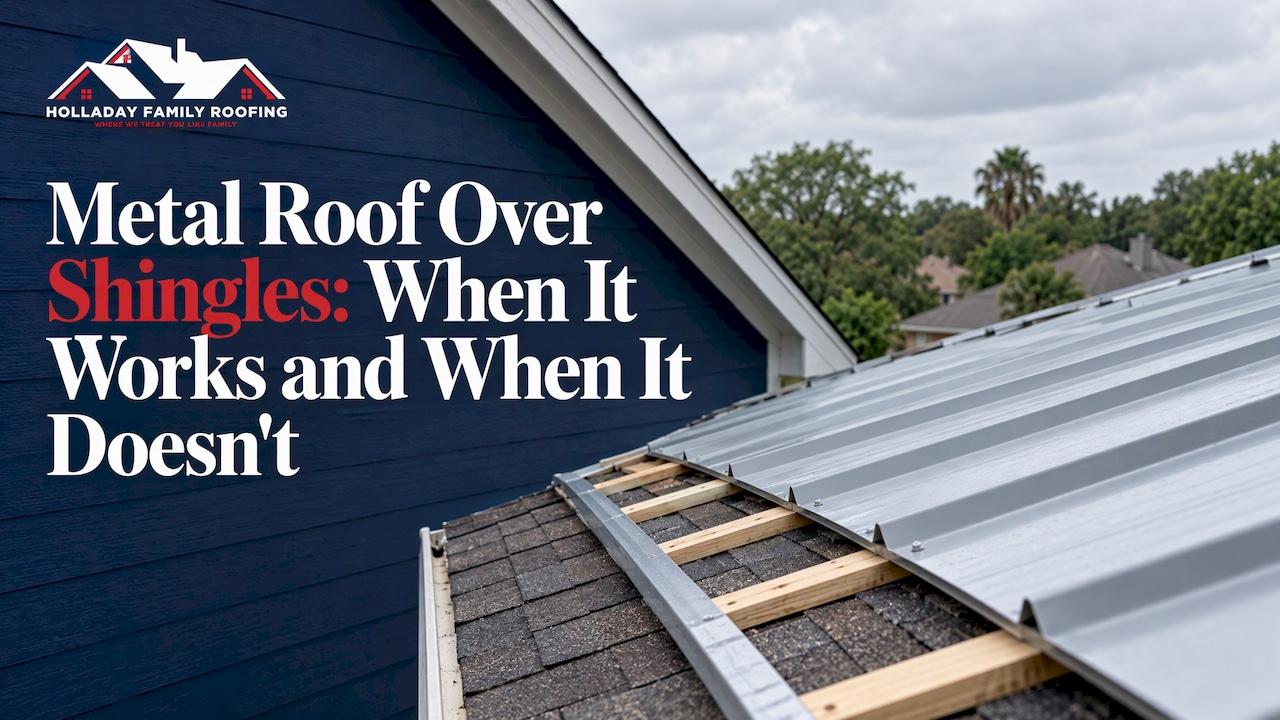
A roof-over, also called a roof recover, means installing the new roof covering on top of the old one instead of stripping the old one off first. With metal, the installer fastens panels either directly over the shingles or over thin wood strips (furring strips or lath) laid across them. Those strips create a flatter surface and a small air space.
A tear-off is the opposite: the old shingles and underlayment come off down to the wood deck, the deck is inspected and repaired, and the new roof goes on a clean surface.
Both are legitimate methods. The question is which one fits your roof's actual condition, and that is something a person has to see in the attic and on the roof surface.
What the building code says
The International Residential Code, the model code that Texas cities and counties often adopt in some edition, addresses this directly. As summarized in a code explainer for metal roof-overs, Section R908.3.1 allows a new roof covering over an existing one when it is installed per the manufacturer's instructions. It also says complete, separate systems that carry their loads to the building's framing, such as standing-seam metal roofs, do not require removal of the old covering.
The same summary lists the situations where a recover is not allowed:
- The existing roof is water-soaked or deteriorated.
- The existing covering is slate, clay, cement or asbestos-cement tile.
- The roof already has two or more applications of any roof covering.
That last point matters in an older neighborhood. If a previous owner already added a second layer of shingles, a metal roof-over is usually off the table and the roof comes down to the deck.
Codes are adopted locally and sometimes amended, so what is allowed in one jurisdiction may not be in the next. Check with your city or county permit office, or ask your roofer which edition applies to your address. Do not assume the national model code is the rule where you live.
Do you need a permit?
Often, yes, especially when you change roofing material. As one example of how local rules read, Mesa County, Colorado's reroof policy requires permits for changing roofing materials, for roofs with two or more layers and for all commercial reroofs, and it requires mid-roof and final inspections. Switching from shingles to metal counts as a material change in a policy like that.
That is one county, not Houston. Your jurisdiction may differ on what needs a permit, who pulls it and what gets inspected. Ask for the requirement in writing before the work begins, and make sure whoever installs the roof handles the permit, not you.
When a roof-over makes sense
A metal roof-over is most realistic when all of these are true:
- One layer only. The roof has a single layer of asphalt shingles.
- Shingles still have life. They are not curling, soaked, crumbling or missing in patches. A recover needs the old roof to be a stable base.
- A dry, solid deck. A roofer's checklist from a Michigan city's permit office lists the same basics: one existing layer, shingles that are not water-soaked or deteriorated, installation that follows the manufacturer's instructions, and any spaced supports securely fastened to trusses or rafters.
- No history of leaks. A roof that has leaked for years often has damp insulation and soft decking you cannot see from above.
- A flat enough surface. Bumps and bowing in the old roof can telegraph through the panels, so the new roof looks uneven.
- The structure can carry the load. The structure needs to handle the extra weight of a second system. A roofer or structural professional should confirm this for your home.
- The metal system allows it. Panel manufacturers publish instructions for what their products can be installed over, and your warranty can depend on following them.
If one of these fails, the answer is a tear-off, and that is nothing to be disappointed about. It means the roof is getting the foundation a 40-year product needs.
The risk you can't see
The core problem with any roof-over is simple: once the metal is on, nobody can look at the deck again without removing both roofs. A code explainer on metal roof-overs names hidden rot as the biggest risk. A soft spot in the wood can let fasteners pull out, and eventually both layers have to come off, which makes the next reroof more expensive.

This is most likely where a roof has leaked before. A small, slow leak around a vent, a chimney or a valley can soak the decking for years without any obvious sign inside. By the time a stain shows on the ceiling, the damage above it can be wide.
If you already see ceiling stains, ceiling water damage repair explains what the interior side of that problem looks like. Do not poke or puncture a sagging ceiling, and do not climb onto a roof you suspect is damaged. A sagging or bulging ceiling can hold water and can be near wiring. Keep people out from under it and have a professional assess it.
What an inspection should look at
A proper inspection before any metal-over-shingle decision covers:
- Number of existing layers, checked at the edges and any open areas.
- Condition of the shingles: curling, granule loss, soft or spongy areas, missing pieces.
- The attic side: dark staining, damp insulation, daylight where there should be none, rusty nail tips, and musty smell.
- Ventilation: whether intake and exhaust are working. Poor ventilation lets summer attic heat build to 140 degrees Fahrenheit or higher and winter moisture condense, according to This Old House.
- Flashing around chimneys, skylights, pipes and walls, which has to be metal-roof compatible.
- Roof pitch and surface flatness.
Holladay Family Roofing's free roof inspection is built for this first look, and there is no price attached to it.
Pros and cons side by side
| Metal over shingles | Tear-off, then metal | |
|---|---|---|
| Removal and disposal | Largely avoided | Required |
| Disruption | Usually less | More debris, more labor days |
| Deck inspection | Not possible once covered | Full view of the deck |
| Deck repair | Only what you can see beforehand | Fix soft or damaged wood before covering |
| Flashing | Often reworked around the old layer | Rebuilt on a clean surface |
| Surface smoothness | Old bumps can show through | Flat base |
| Added weight | Second roof system on the structure | Single system |
| Next reroof | Two layers to remove later | One layer to remove later |
| Warranty | Depends on product and method | Depends on product and method |
The tradeoff comes down to speed and cost now against visibility and a clean base. Some product warranties and programs require a tear-off, so read the terms before you commit to a method.
How a metal roof-over is installed
The steps vary by system, but a careful roof-over generally looks like this:
- Confirm the roof qualifies. Inspect, count layers, check the deck from the attic, and settle the permit.
- Prepare the surface. Replace missing shingles, fix damaged areas, and trim shingles back at the eaves and rakes so edge trim and fasteners seat correctly. Ridge caps and ridge venting material are removed.
- Add underlayment. A layer goes between the old shingles and the metal, following the panel manufacturer's instructions.
- Create a flat plane if needed. Furring strips or lath, fastened into the rafters or trusses, can provide an air gap and be shimmed to straighten a bowed roof. They add cost, labor and weight.
- Flash every penetration. Pipes, chimneys, skylights and walls get metal-roof flashing, not the old shingle details.
- Install panels and trim per the manufacturer's fastening and wind-rating requirements.
- Provide ventilation. Direct attachment makes airflow difficult, so the plan needs to address moisture and attic heat.
There is a cosmetic detail worth knowing too. Wide flat panels can show a rippling effect called oil canning, and this is more likely when panels sit over an uneven surface. Panel profile and a flat substrate both help.
This is work for a trained crew. Metal panels are slick, edges are sharp, and roof-top work near power lines and over damaged decking is dangerous. It is not a weekend project.
What it costs
Cost is where a roof-over looks best on paper. A February 2026 U.S. estimate places an overlay at $7 to $16 per square foot installed and says it may save $1 to $3 per square foot compared with a tear-off. Its example for a 2,000-square-foot roof is $14,000 to $32,000 before project-specific complications.

Treat those as general market ranges, not a quote. Your actual number depends on roof size and pitch, the metal system, the number of penetrations, whether furring strips are needed, and what the deck looks like. Furring and its labor can bring a roof-over close to the price of a tear-off, as noted by one metal panel manufacturer's guide to roof recovers.
The cheaper-now option can cost more later. If the deck is bad, you pay to fix it eventually, and removing two roofs is more work than removing one. When you compare quotes, compare the same scope: same panels, same underlayment, same flashing, same ventilation, same warranty terms.
For broader pricing context, see our guide to roof replacement in Texas.
How long a metal roof lasts when it goes over shingles
Metal roofs generally last 40 to 80 years, according to This Old House. What gets a roof to the long end of that range is not just the metal. The same source lists climate, installation quality, maintenance, roof slope, underlayment, ventilation, color and nearby trees as the factors.
For a roof-over, the practical variables are the ones under the panels. If the old shingles stay damp, the deck stays wet or attic air does not move, the metal on top can outlast the structure that supports it. A light-colored finish in a sunny region can reduce heat absorption and may help roof life, which is relevant in Gulf Coast summers. If color is on your mind, our guide to metal roof colors goes through the choices.
Insurance and storm damage
If the reason you are thinking about a new roof is a storm, handle the claim before you choose a method. Photograph visible damage from the ground, keep any receipts for emergency tarping, and contact your insurance company. Whether a claim covers a full replacement, a repair or nothing depends on your policy and the adjuster's findings, and no contractor can guarantee an outcome. Holladay Family Roofing assists homeowners with insurance claims. If water is already coming in, our guide to emergency roof repair in Houston covers what to do first.
If the roof is leaking now, a roof-over is rarely the right move. Find and fix the source first, and look at the deck. Roof repair may solve a localized problem without replacing anything.
Is a roof-over right for a commercial building?
The same conditions apply, and the stakes are higher. Mesa County's policy, for instance, requires permits for all commercial reroofs. Low-slope commercial roofs often need a different approach altogether, such as a coating over a sound existing membrane. Our roof coatings page covers that option, and the commercial roof replacement guide explains timing and planning.
Why start with Holladay Family Roofing
A roof-over decision depends on facts about your roof that only an on-site look can establish. Holladay Family Roofing has been roofing in Houston for over 20 years, serving Houston, Pearland and Friendswood, and provides free estimates and inspections. Our work includes asphalt shingle, metal, tile and coating systems, plus repair and replacement, so we can tell you which one fits your roof rather than which one we happen to sell.
We also offer a ten-year no-leak warranty. Warranty terms are project-specific, so ask for them in writing and read what they cover before you sign. If you are outside Houston, Pearland or Friendswood, ask us to confirm availability for your address.

To see where your roof stands, request a free estimate or call (832) 883-3930. An estimate request is not a booking and not a price quote. It starts the conversation, and the project-specific price comes after we look at your roof.
FAQ
Can you put a metal roof over shingles?
Often, yes. The model residential code permits a recover when the roof has only one layer, the shingles are not water-soaked or deteriorated and the work follows the manufacturer's instructions. Local codes, your warranty and the condition of the deck can still rule it out, so an inspection comes first.
What are the cons of putting a metal roof over shingles?
The main one is that you cannot inspect or repair the deck once it is covered, so hidden rot can stay hidden. Other concerns are added weight, ventilation, uneven surfaces showing through the panels, and a more expensive reroof later when two layers must come off. Warranties may also depend on the installation method.
Do you need a permit to put a metal roof over shingles?
Usually, because changing roofing material is commonly a permitted job. Rules differ by city and county, so ask the local permit office or have your roofer confirm in writing who pulls the permit and what inspections are required.
How long will a metal roof last over shingles?
Metal roofs generally last 40 to 80 years. Over shingles, the actual number depends on installation quality, ventilation, moisture control and the condition of what is underneath. Your written warranty terms tell you what the installer and manufacturer stand behind.
Is it cheaper to put metal over shingles than tear off?
It can be. One February 2026 estimate puts overlays at $7 to $16 per square foot and savings at $1 to $3 per square foot, though furring strips and deck problems can erase that gap. Only a project-specific estimate gives you your number.
Sources
- Metal roof over shingles: code, cost and installation
- Residential metal roof application checklist and guide
- Mesa County reroof policy
- How long does a roof last?
- Metal roof over shingles: cost, code and installation
- Can a metal roof be installed over my existing roof?
- Ceiling water damage repair